AI drafts the validation documents your team already trusts.
The Documentation Engine drafts your validation deliverables in the style of the templates your organisation already uses — with confidence checks, review gates, and a fully functional fallback when the AI is unavailable. Your team stays in control; the platform removes the drudge work.
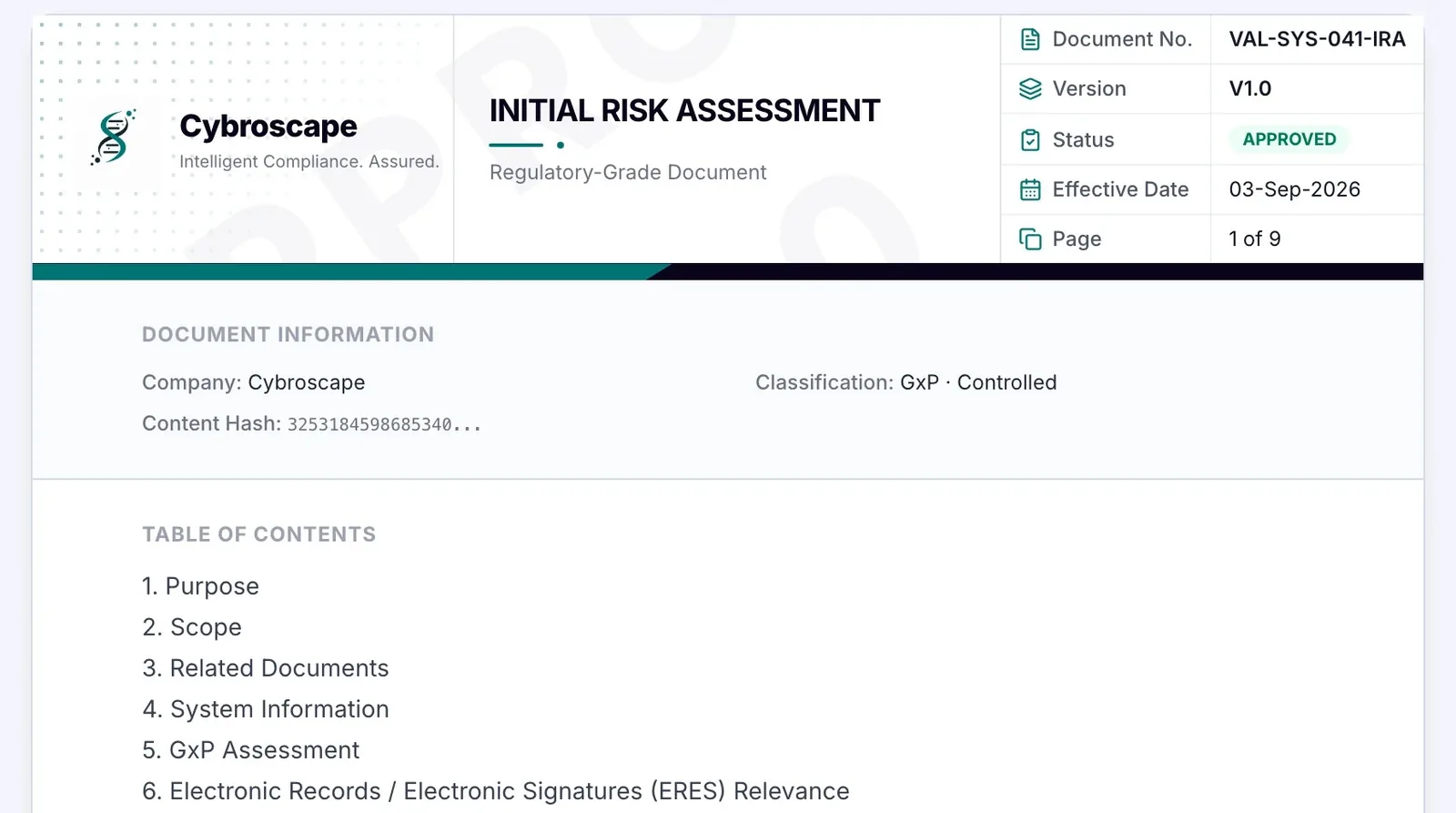
GxP Copilot drafts the full validation or qualification document set from one intake — plan, requirements, risk assessment, protocols and summary report — with every draft grounded in your own source material. A qualified person reviews, edits and approves each one. The drafting is removed; the judgement and the signature stay exactly where they were.
The hours go into assembly, not thinking
Ask a validation lead what took the longest on their last project and the answer is rarely the risk assessment. It is drafting a URS from a vendor specification, writing protocols that follow a predictable structure, formatting evidence, and reconciling a traceability matrix by hand every time a requirement moved.
That is why validation cost tracks document volume rather than system complexity, and why hiring more contractors produces a linear cost increase rather than a step change. More hands do not help when the bottleneck is assembly.
It is also why validation is unpleasant work for skilled people. The regulatory judgement that justifies the salary is a small fraction of the week; the rest is typing structured prose that follows a template.
One intake, the whole set
You provide the source material once. The platform produces the document set the classification calls for: for software, the GAMP 5 lifecycle from validation plan through URS, risk assessment, specifications, IQ/OQ/PQ protocols and summary report; for instruments and equipment, the qualification set including design qualification, factory and site acceptance, calibration and the qualification summary.
Every document arrives as a draft for review, never as a finished record. Nothing becomes controlled until a person has read it and signed it.
- Validation planFor review
- Risk assessmentFor review
- IQ / OQ / PQ protocolsFor review
- Traceability matrixFor review
- Validation summary reportFor review
Grounded in your material, and honest about gaps
Drafts are built from the source document you supplied, and the text they rely on is identifiable. Where the source does not support a statement, the platform says so rather than producing confident prose with nothing behind it — which is the failure mode that makes generated documentation dangerous rather than merely unhelpful.
Requirements are checked for the qualities that make them testable: singular, verifiable, measurable. A requirement that cannot be tested is a problem you want surfaced at drafting, not at protocol execution.
Start from a draft, or from your own document
Not every document should be generated. Where you already have an approved URS, a vendor protocol or an executed supplier test, you can bring it in and work from that instead, and it enters at its real version rather than restarting at v0.1.
This matters for revalidation and for regulated estates where the controlled document already exists and the job is to revise it, not to replace it.
What you get
What AI Validation Document Drafting delivers
AI Validation Document Drafting is part of the GxP Copilot platform — an AI-native, CSA-first validation system built for regulated Life Sciences. See how it fits with AI Classification Engine, Risk-Based Validation Scoping, AI Risk Assessment.
- Drafts in your organisation's template style
- Built-in confidence and review gates
- Works with or without AI — no single point of failure
- Every draft flagged as AI-assisted for the audit
Common questions
Prefer to talk first? Chat with us on WhatsApp or book a call with an expert.
Does the AI write the final validation documents?
It writes the drafts. Nothing becomes a controlled record until a qualified person has reviewed, edited where needed, and signed it under 21 CFR Part 11. The platform removes the assembly work; the regulatory judgement and the accountability stay with the human author and approver.
What stops the AI inventing requirements or regulatory clauses?
Drafts are grounded in the source material you supplied and the supporting text is identifiable, so a reviewer can check any statement against its basis. Where the source does not support a statement the platform flags it rather than producing it confidently. Review is still required — the controls reduce the risk, they do not remove the reviewer.
Can we use our own existing documents instead of generated drafts?
Yes. Any document can start from your own approved version rather than a draft, and it enters the system at its real version number — a URS approved at v12.0 comes in as v12.0 and its next revision is v12.1. This matters for revalidating an estate whose controlled documents already exist.
Related capabilities
All capabilitiesA guided intake — accelerated by AI, decided by your team — produces GxP impact, GAMP category and composite risk, along with the exact reasoning behind each result. Instead of week-long assessments, you get a classification you can defend to an inspector on the same day. The AI accelerates the input; the classification itself is transparent and controlled.
Learn more about AI Classification EngineRisk-Based Validation ScopingThe Strategy Engine picks the applicable deliverable set for each GAMP category and scales test rigor to per-requirement risk under CSA — choosing between scripted testing, unscripted verification, and leveraged supplier evidence. The output is a validation plan sized to reality, easy to defend, and quick to execute.
Learn more about Risk-Based Validation ScopingAI Risk AssessmentEvery requirement is scored against an ICH Q9 lens for severity, probability and detectability. That score drives the test strategy, the traceability coverage and the inspection-readiness view — so risk stops being a compliance formality and starts sizing your actual work.
Learn more about AI Risk AssessmentDocument Control & VersioningEvery document version is fingerprinted and tagged with its provenance and any AI assistance used. Data-driven sections stay canonical across every deliverable — so what you sign is what you keep, and what you keep is what you show an auditor.
Learn more about Document Control & VersioningLive Traceability MatrixThe Live RTM is always up to date — coverage gaps, orphan tests and inspection-readiness are computed on the fly from the links between requirements, design, tests and results. No more spreadsheet upkeep, no more RTM-freshness debates before an audit.
Learn more about Live Traceability MatrixAI Test Case GenerationInstallation, Operational and Performance Qualification protocols are drafted from your requirements and design, right-sized by the risk engine, and structured for straightforward execution. Effort follows risk — high risk is scripted with an independent witness, medium is scripted or hybrid, and low risk can be unscripted with supplier evidence.
Learn more about AI Test Case GenerationSources
Primary documents referred to on this page, from their official publishers.
See validation document drafting on your own requirements.
One real requirements document. We show you the draft package built from it, and you keep it either way.
- We reply within one business day
- We run your URS live on the call
- You get a clear plan for your system