TraceDraft
Validated, source-traceable document generation for clinical and regulatory submissions.
Turn writer capacity into a strategic advantage — AI-assisted clinical documents where every sentence traces back to the source data, with the compliance evidence attached on export.
TraceDraft clients across life sciences



Every claim traceable to its source, on export.
TraceDraft accelerates clinical and regulatory writing for CROs, biotech, med-device and pharma teams — Clinical Study Reports, protocols and amendments, Investigator Brochures, DSURs, IND annual reports, HAQ responses, IND packages, safety narratives and Clinical Evaluation Reports. Every generated sentence links back to the source data that produced it, so sponsors, auditors and regulators can walk any claim back to its origin. A dedicated review queue keeps human medical writers in the loop; a tamper-evident audit trail keeps the compliance evidence ready. Writers stop assembling and start deciding — throughput goes up, quality holds, and AI use becomes something you can actually defend to a sponsor.
Not summaries, not vibes — a defensible link from every sentence back to the underlying AE listing row, dataset value or protocol clause.
Tamper-evident audit trail and real electronic signatures, so AI-assisted writing meets the same regulatory bar as human writing.
The AI provider is swappable. Start today; move to a preferred model tomorrow — without touching your workflows or SOPs.
Strict client-by-client isolation, so CROs and enterprise teams can host multiple studies and sponsors under one platform.
Drafts leave the system with their traceability and QC record attached — inspection posture arrives with the document.
See it working.
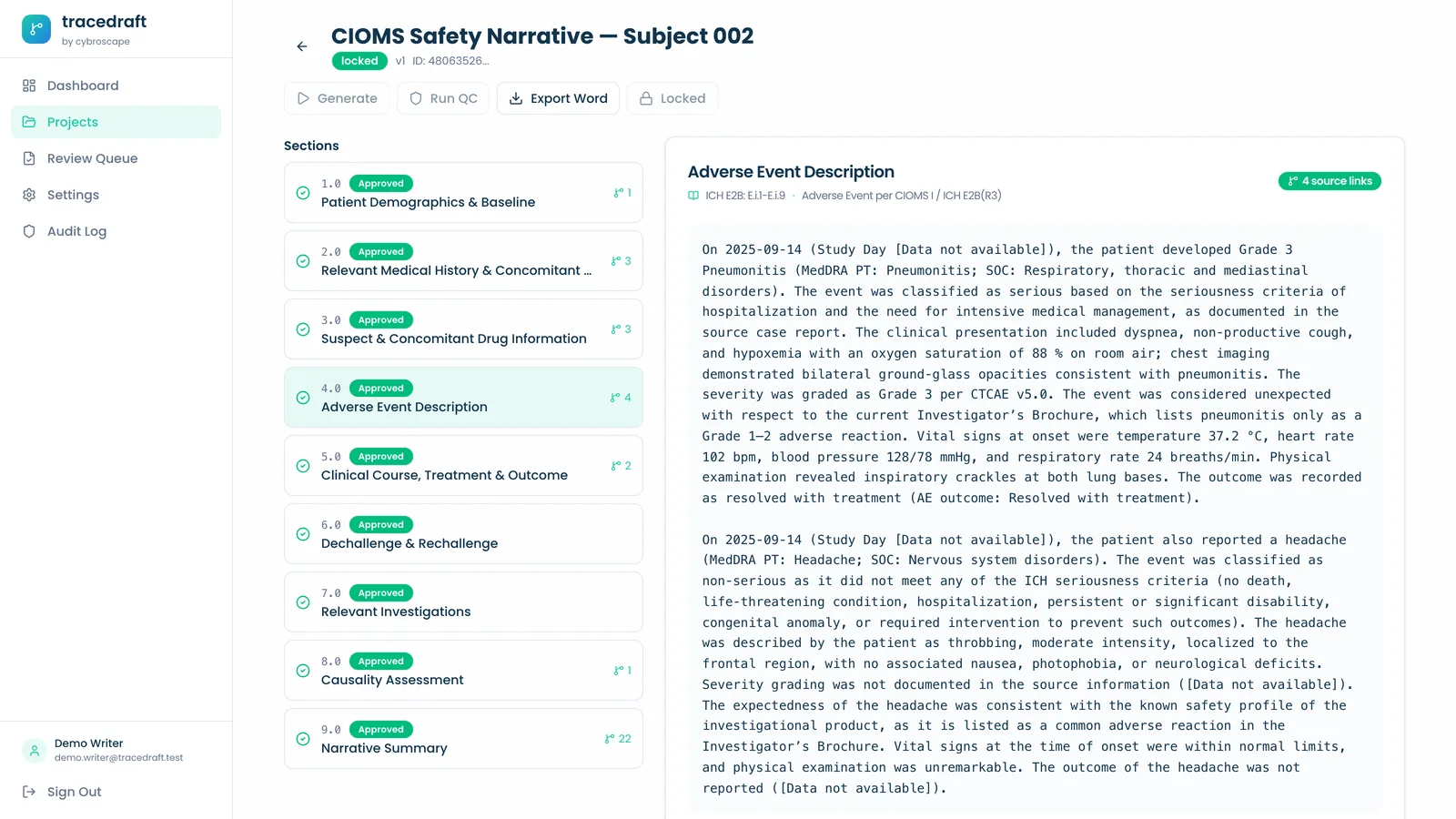
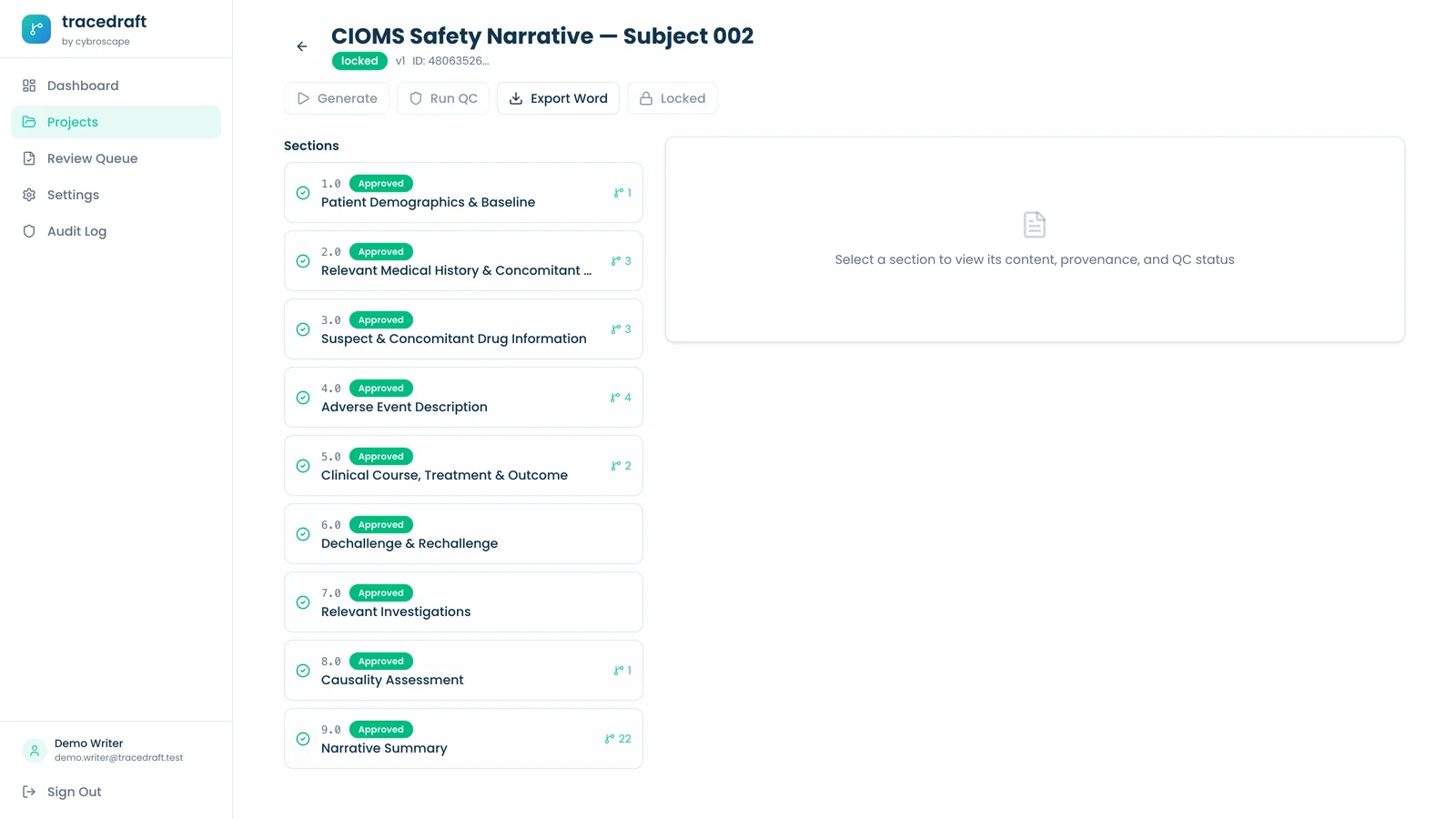
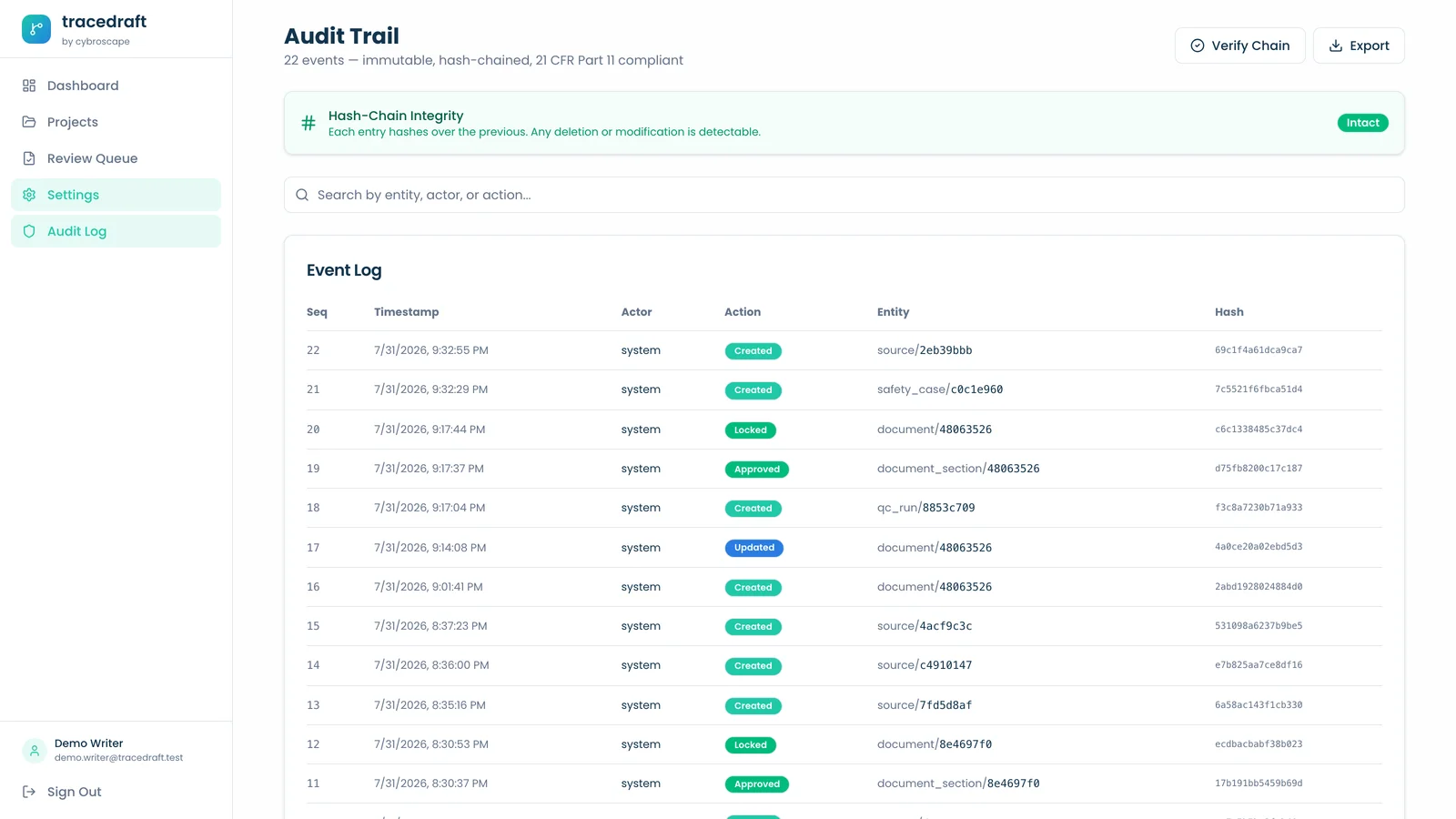
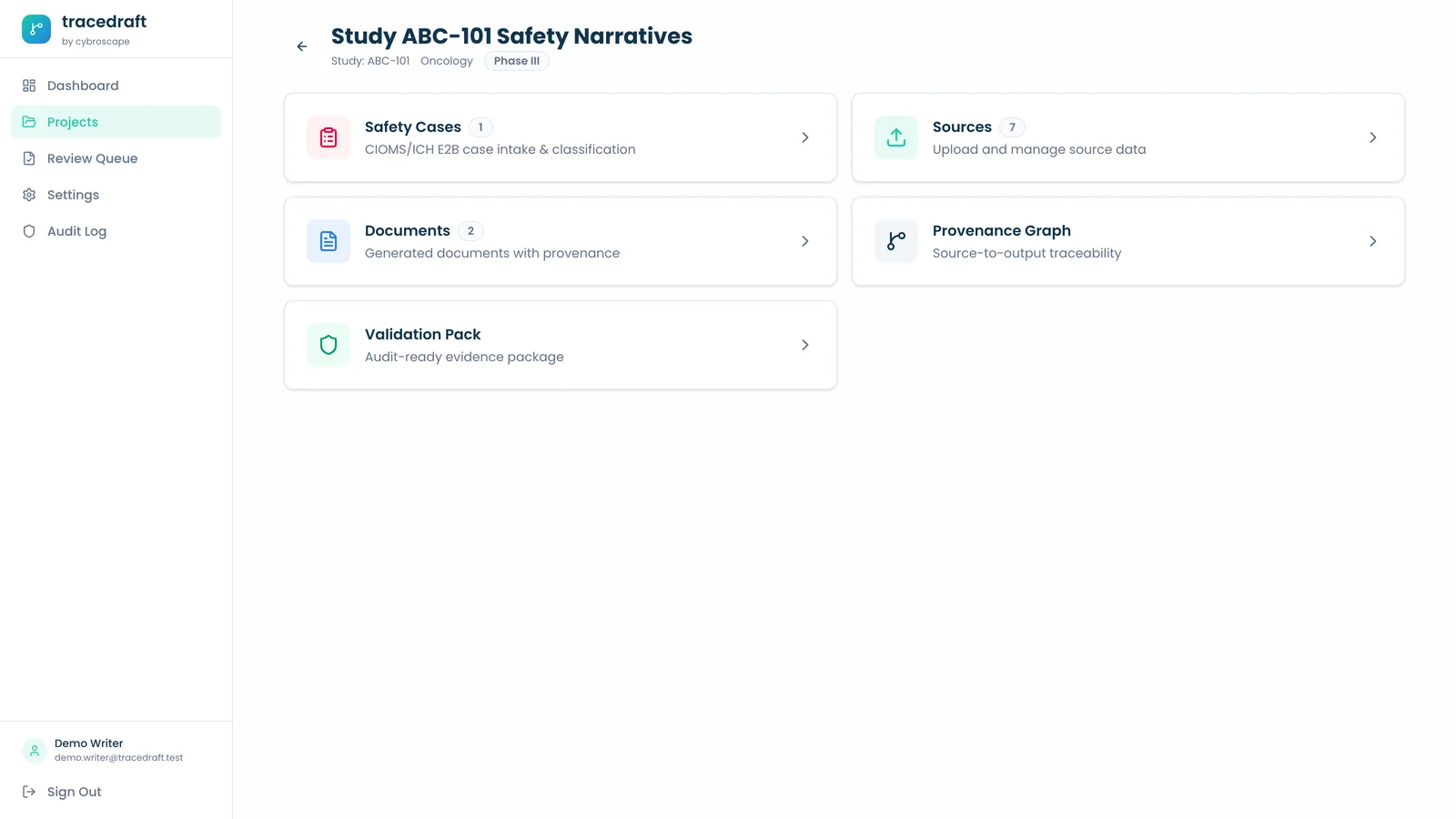
Real screenshots from TraceDraft — an approved safety narrative, its sections, the audit trail and the study project.
From source data to a signed, traceable document
Six steps, two signature gates, and every statement linked to where it came from.
Your study's source documents and data, organised and checked for gaps before drafting starts.
The writer confirms the source set for the document.
The TraceDraft capability stack
Every capability has its own page, written for search and generative engines alike. Pick one to see how it works.
Compose Clinical Study Reports from your linked source data — AE listings, datasets, protocols — and generate the safety narrative appendix straight from the same source graph. One review workflow, one evidence pack, one traceable story from listing to submission.
Learn more about CSR AuthoringProtocols + amendmentsProtocol WritingDraft and revise protocols and protocol amendments in one workspace with the study's sources and templates. Amendments inherit the audit trail and status workflow so revisions stay traceable and reviewable — not lost in tracked-changes.
Learn more about Protocol WritingIB, DSUR, IND annual, HAQ, INDMedical WritingA general-purpose medical writing workspace for Investigator Brochures, DSURs, IND annual reports, HAQ responses, IND packages and other regulatory documents. Writers work section-by-section against your templates, grounded in the source data that must support every claim.
Learn more about Medical WritingAE narratives with source linksSafety NarrativesA standard safety narrative template — Patient Identification, AE Description, Medical History, Study Drug, Clinical Course, Causality and Narrative Summary — with each section wired to the source types it needs. The final narrative slots directly into the CSR appendix.
Learn more about Safety NarrativesMDR / CERClinical Evaluation ReportsClinical Evaluation Reports authored with the same source-traceability engine used for CSRs — traceable claims, tamper-evident audit, MDR / IVDR-ready evidence, without a bespoke module.
Learn more about Clinical Evaluation ReportsCited via provenanceLiterature ReviewsLiterature ingested once, cited everywhere — with the same traceability links used across the rest of the platform. Purpose-built literature-review tooling is on the roadmap.
Learn more about Literature ReviewsSource ingest + coverageClinical DocumentationProject-scoped source management ingests the messy inputs — AE listings, datasets, protocols, PDFs — and turns them into the citable atoms behind every generated section. Writers see source coverage before they draft, so gaps are addressed early, not at QC.
Learn more about Clinical DocumentationReview queue with source linksHuman-in-the-Loop ReviewsA dedicated review queue routes generated sections to human reviewers with the source-link count in view — so reviewers validate AI output against the actual data behind it. The section status workflow keeps everyone honest about where a draft actually is.
Learn more about Human-in-the-Loop ReviewsOperational cockpitClinical IntelligenceThe dashboard aggregates active projects, documents, sources and coverage — plus compliance posture (Part 11 controls, AI governance) at a glance. An operational cockpit for a medical writing function, not a BI product.
Learn more about Clinical IntelligenceAsync work, human gatesClinical AutomationGeneration, extraction and export run asynchronously so writers never wait for a spinner. Combined with the swappable AI provider, teams can automate draft production while keeping the human review gate exactly where it belongs.
Learn more about Clinical AutomationCSR turnaround cut, source-traceable AI adopted across 14 active studies
A mid-cap CRO's medical writing team was capacity-bound on CSR turnaround.
Read the case studyEverything a medical writing lead asks before buying
What Source Traceability Actually Means
Most concerns about AI in regulatory writing are about tone. Tone is not the risk. The risk is a sentence that reads well, sounds correct, and is not supported by the data it refers to — because an obvious error gets caught and a fluent one does not, particularly on page 180 of a document a reviewer has read four versions of.
TraceDraft is built so every factual statement carries its provenance: the table, listing or dataset value it came from. A reviewer confirms it in place rather than leaving the document to hunt for a source. That changes review from reading for plausibility into checking against a source, which is the only form of review that holds at length.
It also changes what happens when the data changes, which it always does. A re-run analysis, a corrected dataset, a late query resolution. Where statements are linked to sources, the statements affected by a changed table are identifiable. Where they are not, somebody re-reads the document and hopes.
The Documents It Drafts, and the Ones It Does Not
Clinical Study Reports, protocols and their amendments, Investigator Brochures, DSURs, safety narratives, and Clinical Evaluation Reports under EU MDR. The common property is that each is largely a structured restatement of material that already exists — the tables are produced, the analyses are run, the protocol said what would be done.
What it does not draft is the interpretation. The benefit-risk discussion, the clinical conclusions, causality assessment on an individual event, and the company comment are judgements a qualified person makes and signs. A system that drafts the descriptive sections and leaves those fields is working correctly. One that proposes a conclusion is doing something categorically different and should be assessed as such.
Consistency Across Three Hundred Pages
Ask a medical writer what consumes a submission cycle and the answer is rarely the first draft. It is reconciliation: the same figure appearing in the synopsis, the body, a table and the discussion, and making all four agree after the third data refresh.
This is mechanical work that people do badly, not through carelessness but because it requires holding hundreds of pages in mind at once. It is also the work most likely to produce a finding, because an inconsistency between the synopsis and the body is the first thing a reviewer notices and the thing they draw conclusions from.
Checking consistency against source rather than against other prose is a larger practical gain than generating the first draft, and it is the part that is least impressive to demonstrate.
Review That Is Genuinely Review
Human-in-the-loop is claimed by every vendor in this category and demonstrated by few. The question is not whether a person reviews the output. It is whether rejecting it is as easy as accepting it, because people defer to automated output and that tendency strengthens the longer the system is usually right.
So the review gate is enforced by the system rather than by a procedure: output cannot reach an approved state without a qualified signature, and the reviewer sees the source alongside the statement. If accepting is one click and rejecting takes a justification, a reassignment and a conversation, the control has a thumb on the scale whatever the SOP says.
21 CFR Part 11 Posture, Not a Part 11 Claim
Documents produced here are regulated records, so the controls are the ordinary ones and they have to be real: attributable actions, a tamper-evident audit trail, electronic signatures that meet the requirement rather than resembling it, and retention that keeps the original reachable rather than only the derived version.
Worth stating plainly, because the category is noisy about it: no regulator certifies software as Part 11 compliant. A vendor can make compliance easier or harder; the validated state belongs to your implementation, in your process, for your intended use.
Validating AI That Writes Regulatory Documents
A tool producing submission content is a computerised system and validates on the usual terms, with additions specific to AI. A stated intended use including what it is explicitly not for. Acceptance criteria defined before evaluation rather than after seeing results. An evaluation set with known-correct outputs that gates each release.
And one test the generic quality measures will not give you: a specific check for statements unsupported by source. An average accuracy figure hides the occasional fabricated reference, and an occasional fabricated reference in a regulatory document is the entire risk. Plus drift monitoring with a threshold set in advance, and a fallback path that has been exercised rather than documented.
Built for CROs and Multiple Sponsors
Strict client-by-client isolation, so a CRO or an enterprise team can run many studies and sponsors on one platform without the data of one reaching another. For a service organisation this is usually the first question asked and the one that decides the evaluation.
The AI provider is swappable by design. Starting today does not commit you to a particular model for the life of the contract, and moving later does not mean touching your workflows or rewriting your SOPs.
What Arrives With the Document
Drafts leave the system with their traceability and QC record attached, so the inspection posture travels with the document rather than being assembled afterwards from memory and email.
The practical test of whether that matters: pick a sentence in a submitted report and ask which dataset value it rests on. If answering takes an afternoon, the evidence existed and was not kept. If it takes a moment, that is the difference this is built to produce.
Sources
Primary documents referred to on this page, from their official publishers.
Product plus the team that runs it
TraceDraft FAQs
The questions we get before every first call, answered plainly. Prefer to talk first? Chat with us on WhatsApp.
What documents can TraceDraft author?
Clinical Study Reports (CSRs), Protocols and Amendments, Investigator Brochures, DSURs, IND annual reports, HAQ responses, IND packages, Safety Narratives, Clinical Evaluation Reports and general study documents.
How does source traceability work?
Every generated output — sentence, table, section — is linked back to the underlying clinical source that produced it (an AE listing row, a dataset value, a protocol clause). Reviewers see the exact source behind every claim, and on export the traceability travels with the document.
Is TraceDraft 21 CFR Part 11 compliant?
The audit trail is tamper-evident and cannot be silently edited by the application. Electronic signatures require re-authentication and record the ceremony 21 CFR Part 11 demands — so AI-assisted writing meets the same regulatory bar as human writing.
Can we bring our own AI provider?
Yes — the AI provider is swappable. Teams can start on our default configuration today and move to a preferred model tomorrow without touching workflows or SOPs.
Is TraceDraft multi-tenant?
Yes — designed with strict client-by-client isolation, so CROs and enterprise teams can safely run multiple studies and sponsors on the same platform.
Does using AI mean writer teams shrink?
In practice, writer capacity gets redirected. TraceDraft removes assembly work — copying between source files, chasing citations, reconciling appendices — so your writers spend more time on the calls that need judgment. Throughput rises; quality holds.
See TraceDraft run on your own data.
Bring a protocol, a TLF set or an AE listing. We show you a source-traced draft built from it.
- We reply within one business day
- We run your inputs live on the call
- You see every sentence linked to its source