Every clinical detail must trace to the source listing.
A standard safety narrative template — Patient Identification, AE Description, Medical History, Study Drug, Clinical Course, Causality and Narrative Summary — with each section wired to the source types it needs. The final narrative slots directly into the CSR appendix.
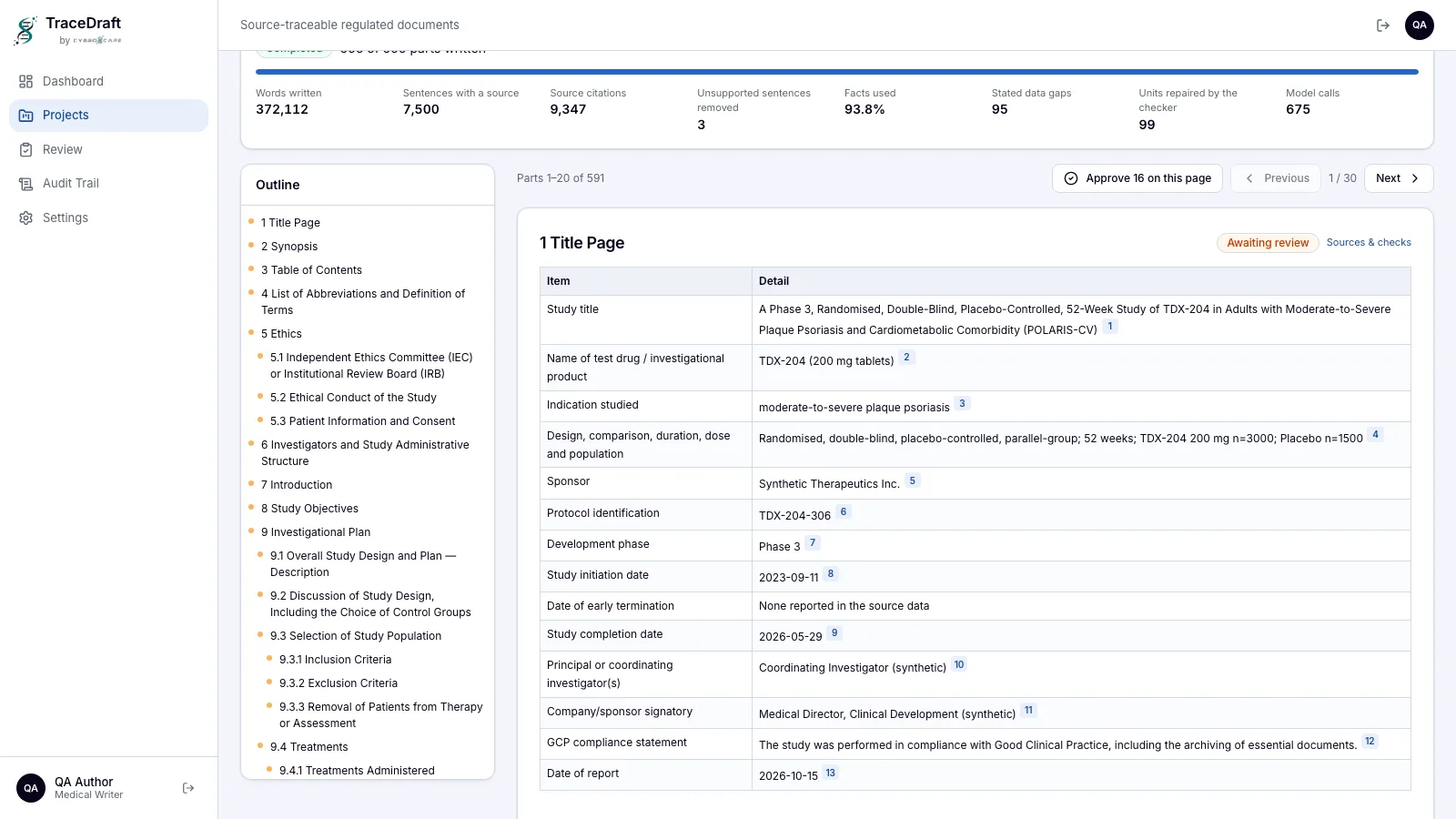
A safety narrative is a short written account of a serious adverse event — what happened to the patient, in what order, with what treatment and what outcome — assembled from the AE, concomitant medication, medical history and lab datasets. TraceDraft drafts them with every statement linked back to the dataset row it came from, for a medical reviewer to check and approve.
The most mechanical writing in clinical research
A narrative is a prose restatement of structured data. The writer opens the AE listing, finds the event, cross-references concomitant medications by date, checks medical history for confounders, pulls the relevant lab values, and writes it up in a house style that varies little between events.
Then they do it several hundred more times for the same study. It is precise, exacting work that requires clinical judgement in perhaps one case in ten and careful transcription in the other nine.
The consequence is a queue. Narratives are near the end of the critical path, the volume is known only once the database locks, and the writers capable of doing them are the same people needed for the CSR.
Drafted from the data, not from a summary
Narratives are built from the source datasets rather than from an intermediate summary, so the sequence of events, the dates, the doses and the outcomes come from the listings themselves.
Every statement carries a link back to the row it came from. A reviewer checking whether the concomitant medication start date is right follows the link rather than opening the dataset separately and searching — which is the difference between a narrative that takes four minutes to check and one that takes twenty.
- 1Adverse event listing · row 14
- 2Lab dataset · ALT value, day 15
- 3Protocol · section 7.2
What the model is not allowed to do
Causality assessment, expectedness and seriousness are clinical judgements. They are carried from the data where they already exist and flagged for the reviewer where they do not. The system does not infer them, because a narrative that quietly assigns its own causality is worse than no narrative at all.
Where the source data does not support a statement, it is flagged rather than written confidently. Fluent prose with nothing behind it is the specific failure mode that makes AI dangerous in this work rather than merely unhelpful.
Consistency across a study
Narratives for the same study should read as though one person wrote them. In practice they are split across writers under time pressure and the house style drifts — different tense conventions, different levels of detail, different handling of ongoing events.
A drafted set starts consistent. The reviewer is then correcting clinical content rather than normalising style, which is both faster and a better use of a medical reviewer.
What you get
What Safety Narratives delivers
Safety Narratives is part of the TraceDraft platform — an AI-native, source-traceable clinical documentation system built for regulated Life Sciences. See how it fits with CSR Authoring, CTD Clinical Summaries, Document Analysis.
- Standard AE narrative template
- Each section wired to required source types
- CSR appendix passthrough
- Section-level human review
Common questions
Prefer to talk first? Chat with us on WhatsApp or book a call with an expert.
What is a safety narrative?
A short written account of a serious adverse event — the patient's relevant history, the event with its onset and duration, concomitant medications, treatment given, the investigator's causality assessment and the outcome. It is assembled from the AE, concomitant medication, medical history and laboratory datasets and included in the CSR and regulatory submissions.
Can AI write safety narratives?
It can draft them, and a narrative is unusually well suited to drafting because it is largely a prose restatement of structured data. What it must not do is infer clinical judgements — causality, expectedness and seriousness belong to the investigator and the medical reviewer, and a system that quietly assigns them is worse than no system.
How do you verify an AI-drafted narrative?
By following each statement to the dataset row behind it. If verification means opening the source listing separately and searching for the record, review costs as much as writing and the exercise is pointless. The provenance link is what makes checking a four-minute task rather than a twenty-minute one.
Related capabilities
All capabilitiesCompose Clinical Study Reports from your linked source data — AE listings, datasets, protocols — and generate the safety narrative appendix straight from the same source graph. One review workflow, one evidence pack, one traceable story from listing to submission.
Learn more about CSR AuthoringCTD Clinical SummariesDraft CTD Module 2.5 Clinical Overviews and Module 2.7 Clinical Summaries from your clinical study reports and integrated analyses. Each section carries the ICH M4E(R2) text it must satisfy, every sentence cites the study report passage or table behind it, and the benefit-risk conclusions stay with your writers.
Learn more about CTD Clinical SummariesDocument AnalysisUpload an existing CSR, a vendor validation protocol, an SOP or a guideline and TraceDraft analyses it against the structure it should follow: a section-by-section summary, what each required section covers, what is missing, and where the text disagrees with itself. Every finding cites the uploaded document.
Learn more about Document AnalysisClinical DocumentationProject-scoped source management ingests the messy inputs — AE listings, datasets, protocols, PDFs — and turns them into the citable atoms behind every generated section. Writers see source coverage before they draft, so gaps are addressed early, not at QC.
Learn more about Clinical DocumentationHuman-in-the-Loop ReviewsA dedicated review queue routes generated sections to human reviewers with the source-link count in view — so reviewers validate AI output against the actual data behind it. The section status workflow keeps everyone honest about where a draft actually is.
Learn more about Human-in-the-Loop ReviewsClinical AutomationGeneration, extraction and export run asynchronously so writers never wait for a spinner. Combined with the swappable AI provider, teams can automate draft production while keeping the human review gate exactly where it belongs.
Learn more about Clinical AutomationSee safety narratives on your own data.
Bring a protocol, a TLF set or an AE listing. We show you a source-traced draft built from it.
- We reply within one business day
- We run your inputs live on the call
- You see every sentence linked to its source