Reviewers can validate every sentence against the source that produced it.
A dedicated review queue routes generated sections to human reviewers with the source-link count in view — so reviewers validate AI output against the actual data behind it. The section status workflow keeps everyone honest about where a draft actually is.
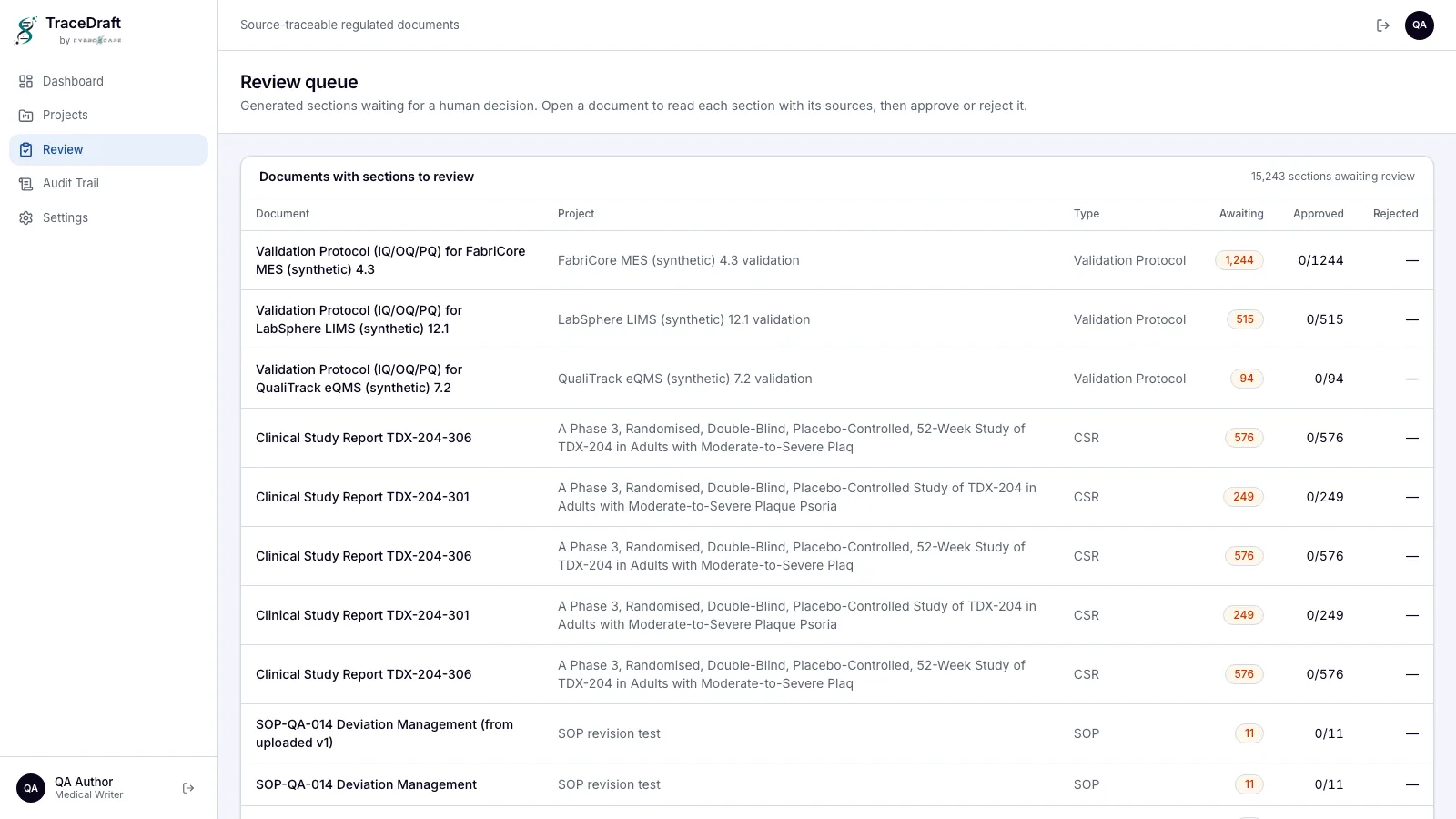
Human-in-the-loop review means a qualified person checks AI-drafted clinical content against its source and approves it, with the decision recorded against their name. In TraceDraft the reviewer sees the draft and the dataset row, table or publication it draws on side by side, so verification is a glance rather than a separate investigation.
Review that cannot realistically happen
Hand a reviewer a fluent document and no practical way to check it against source, and they will approve it. Not through carelessness — verifying each statement means opening the dataset separately, locating the record and repeating that a hundred times. Nobody has that afternoon, and the document is due.
This is the central risk of AI in clinical documentation, and it is a workflow failure rather than a model failure. A better model writes more convincing prose, which makes shallow review more likely rather than less.
A signature from someone who had no affordable way to verify the content is not oversight. It is a signature.
Source alongside draft, always
Each statement links to the dataset row, table cell or publication passage it came from. Checking a concomitant medication date, a lab value or a cited claim is a click rather than an expedition into the source system.
This single design decision determines whether AI-assisted writing saves time overall. Generation speed is irrelevant if verification expands to absorb it, which is the honest reason most clinical AI pilots stall.
- Signer’s name
- Date and time
- Meaning of the signature
- Entry in the audit trail
Partial acceptance
Reviewers accept some sections and send others back without regenerating the whole document. A narrative with one wrong causality statement should not cost a full redraft, and a system that forces one teaches reviewers to accept rather than challenge.
Accepted sections stay accepted through subsequent revisions, so review effort accumulates rather than resetting.
Decisions that are recorded, not assumed
Every approval and rejection is attributable to a named person, a rejection needs a written reason, and a document can only be locked once every section is approved. Each of these events is written to a hash-chained audit trail that can be verified end to end.
These are enforced by the system rather than described in an SOP, because procedural separation depends on people remembering a rule under deadline pressure.
What you get
What Human-in-the-Loop Reviews delivers
Human-in-the-Loop Reviews is part of the TraceDraft platform — an AI-native, source-traceable clinical documentation system built for regulated Life Sciences. See how it fits with CSR Authoring, CTD Clinical Summaries, Document Analysis.
- Review queue with SLA
- Source-link count per section
- Enforced status workflow
- Reject with reason and audit
Common questions
Prefer to talk first? Chat with us on WhatsApp or book a call with an expert.
What does human-in-the-loop mean for clinical documents?
That a qualified person verifies AI-drafted content against its source and approves it, with the decision recorded against their name. The AI drafts; the human checks and decides, and remains the accountable author of the record as far as a sponsor or regulator is concerned.
How do you stop review becoming a rubber stamp?
By making verification cheap. If checking a statement means opening the source dataset separately and searching, review will be superficial regardless of policy. Showing the source alongside the draft, and flagging statements the source does not support, is what makes genuine review affordable at document volume.
How is a review decision recorded?
Each approval or rejection is recorded against the named reviewer, with the reason for any rejection, in a hash-chained audit trail. A document can only be locked once every section is approved, and a locked document is frozen: later changes go into a new version.
Related capabilities
All capabilitiesCompose Clinical Study Reports from your linked source data — AE listings, datasets, protocols — and generate the safety narrative appendix straight from the same source graph. One review workflow, one evidence pack, one traceable story from listing to submission.
Learn more about CSR AuthoringCTD Clinical SummariesDraft CTD Module 2.5 Clinical Overviews and Module 2.7 Clinical Summaries from your clinical study reports and integrated analyses. Each section carries the ICH M4E(R2) text it must satisfy, every sentence cites the study report passage or table behind it, and the benefit-risk conclusions stay with your writers.
Learn more about CTD Clinical SummariesDocument AnalysisUpload an existing CSR, a vendor validation protocol, an SOP or a guideline and TraceDraft analyses it against the structure it should follow: a section-by-section summary, what each required section covers, what is missing, and where the text disagrees with itself. Every finding cites the uploaded document.
Learn more about Document AnalysisSafety NarrativesA standard safety narrative template — Patient Identification, AE Description, Medical History, Study Drug, Clinical Course, Causality and Narrative Summary — with each section wired to the source types it needs. The final narrative slots directly into the CSR appendix.
Learn more about Safety NarrativesClinical DocumentationProject-scoped source management ingests the messy inputs — AE listings, datasets, protocols, PDFs — and turns them into the citable atoms behind every generated section. Writers see source coverage before they draft, so gaps are addressed early, not at QC.
Learn more about Clinical DocumentationClinical AutomationGeneration, extraction and export run asynchronously so writers never wait for a spinner. Combined with the swappable AI provider, teams can automate draft production while keeping the human review gate exactly where it belongs.
Learn more about Clinical AutomationSee human-in-the-loop reviews on your own data.
Bring a protocol, a TLF set or an AE listing. We show you a source-traced draft built from it.
- We reply within one business day
- We run your inputs live on the call
- You see every sentence linked to its source