GxP Copilot
AI-native, CSA-first computer system validation for Life Sciences.
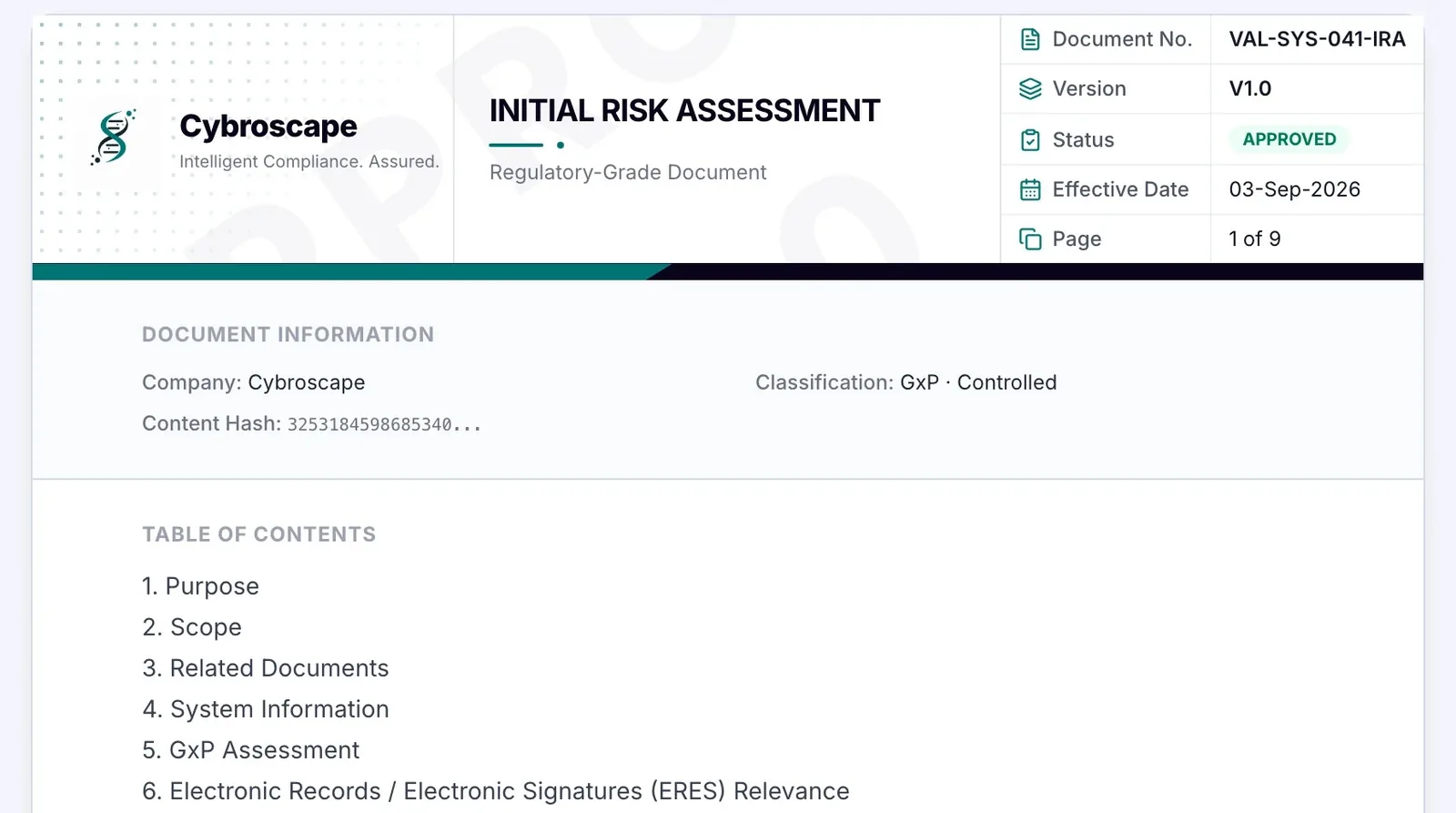
Cybroscape GxP Copilot is AI validation software for pharma, biotech, CDMO, CRO and medical device teams. From one intake it drafts the CSV or CSA validation package: requirements, risk assessment, test cases and a live traceability matrix. Qualified people review and sign every deliverable under 21 CFR Part 11.
GxP Copilot clients across life sciences



Ship inspection-ready systems in a fraction of the time.
GxP Copilot compresses computer system validation from months to weeks — for pharma, biotech, medical device, CRO and diagnostics teams that need to ship compliant systems quickly, without adding QA headcount or absorbing a year-long incumbent rollout. A short intake produces a complete, GAMP 5 Second Edition-aligned validation package, sized to real per-requirement risk under FDA's Computer Software Assurance guidance. Your validation leads review, refine and sign; the platform handles the drafting, traceability and evidence assembly. Every action is captured in a tamper-evident audit trail with real 21 CFR Part 11 electronic signatures — so you are inspection-ready the day you go live.
A full GAMP 5 validation package drafted in days, not quarters — freeing your team to focus on judgment calls, not document assembly.
Test rigor scales to real per-requirement risk under FDA CSA, so you spend effort where it changes the outcome and defensibly reduce it everywhere else.
Tamper-evident audit trail, real Part 11 electronic signatures, and live traceability — the posture regulators expect, without a remediation project.
The platform ships with AI assurance aligned with the EU GMP Annex 22 consultation draft — model governance, human-in-the-loop, and a working workflow even when the AI is off. AI accelerates; humans decide.
Designed for Series A–C biotech, CDMOs, medical-device startups and digital-health scale-ups — teams that need regulated-grade validation without a large validation department.
See it working.
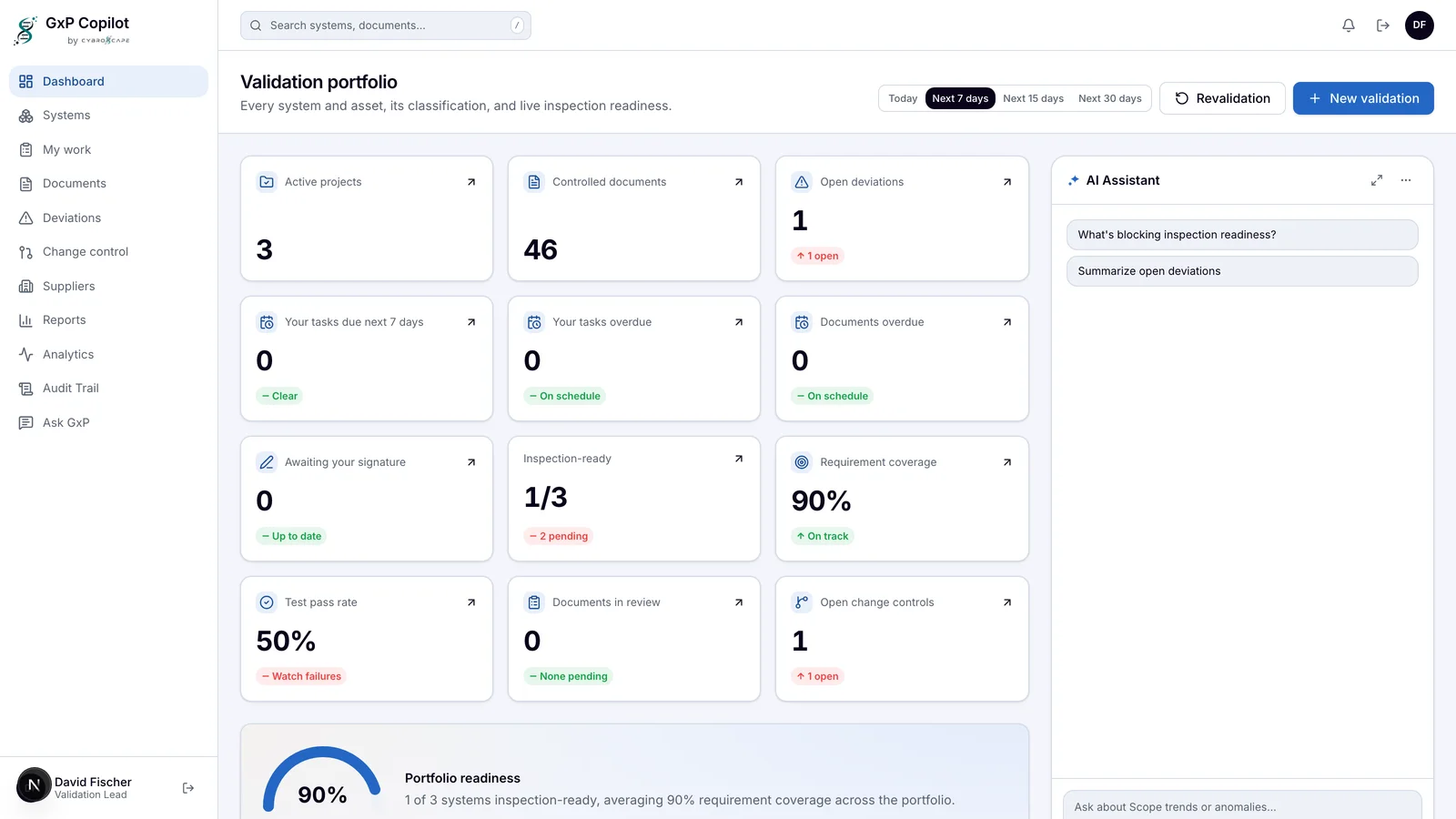
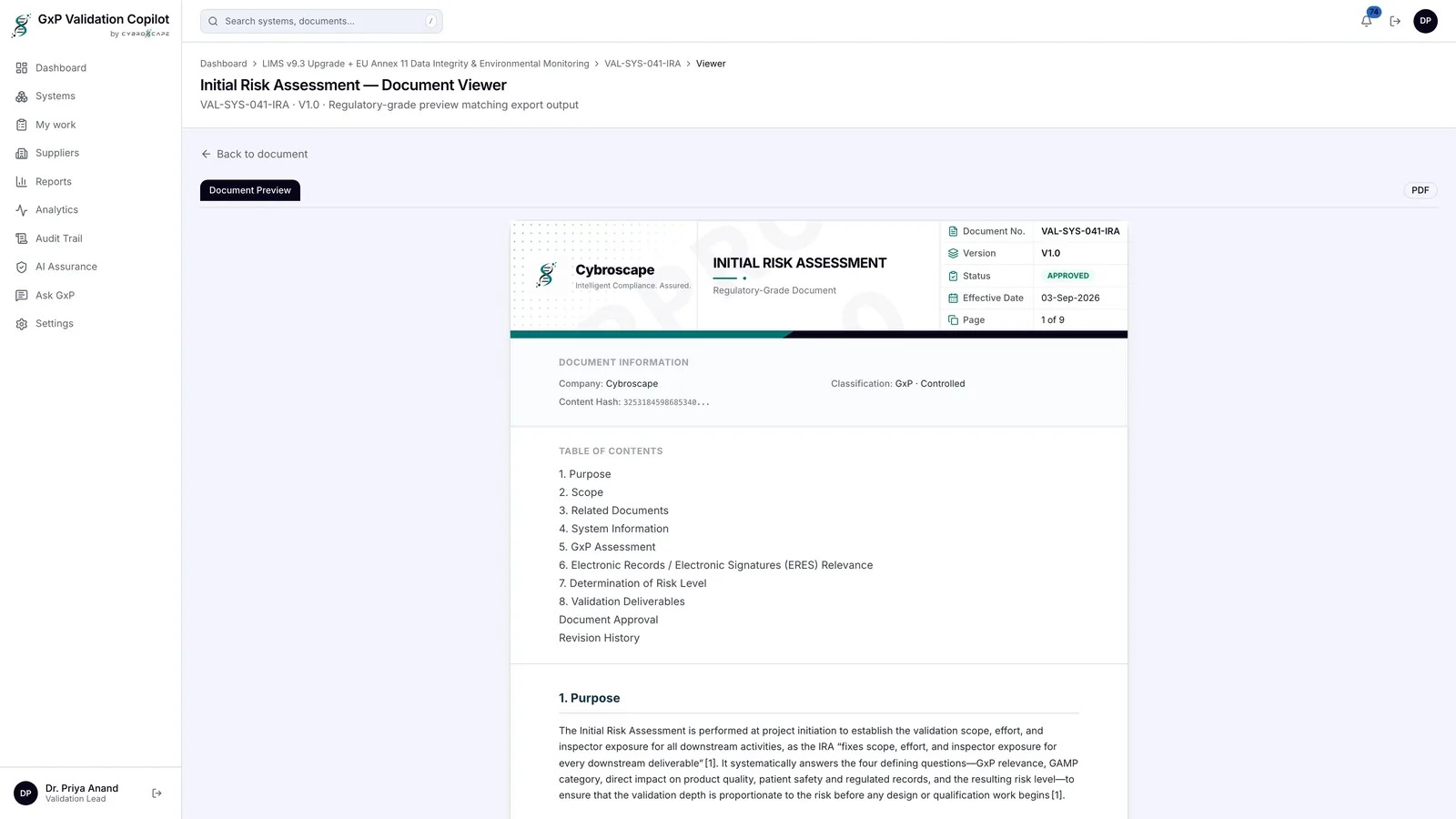
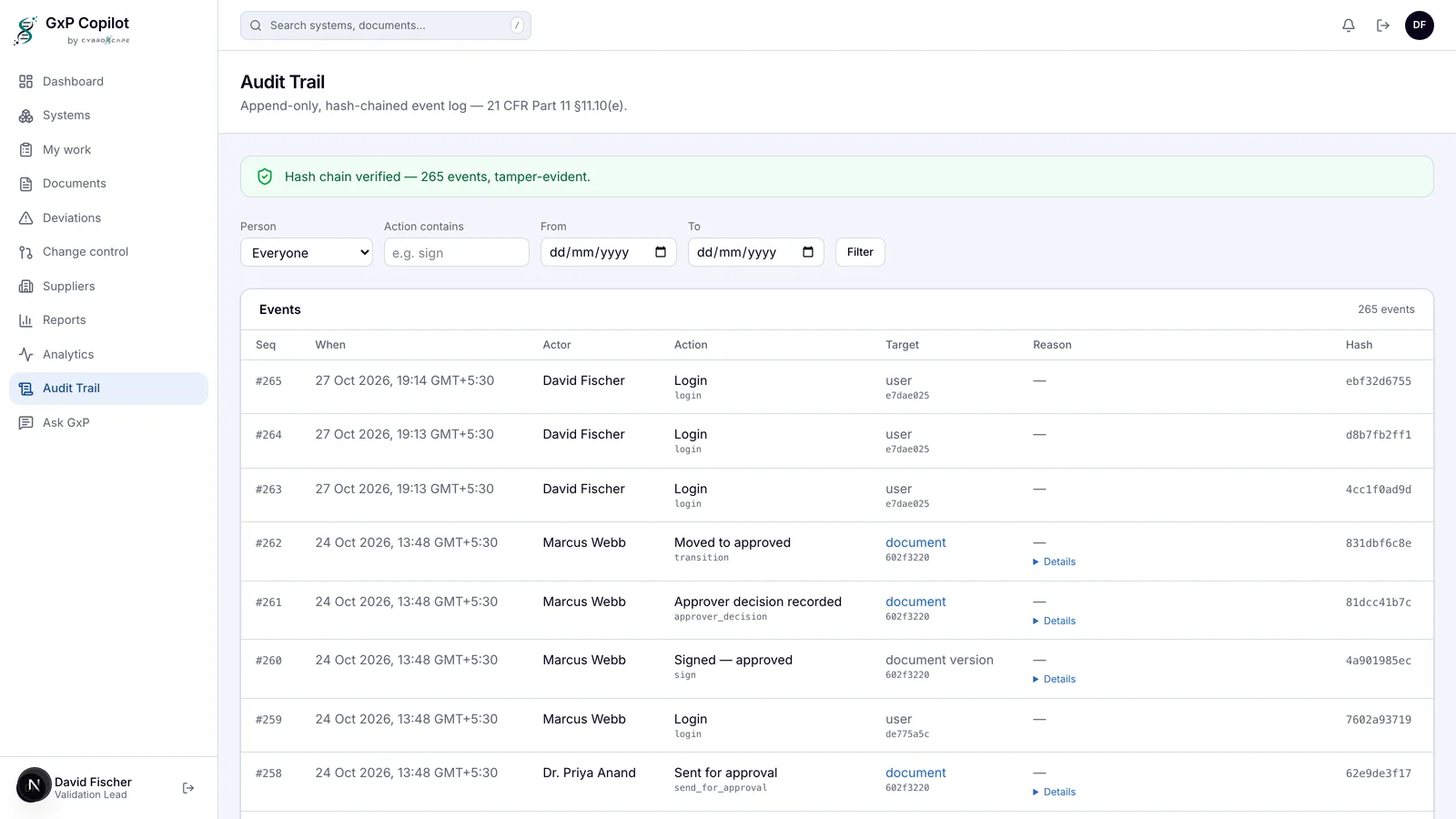
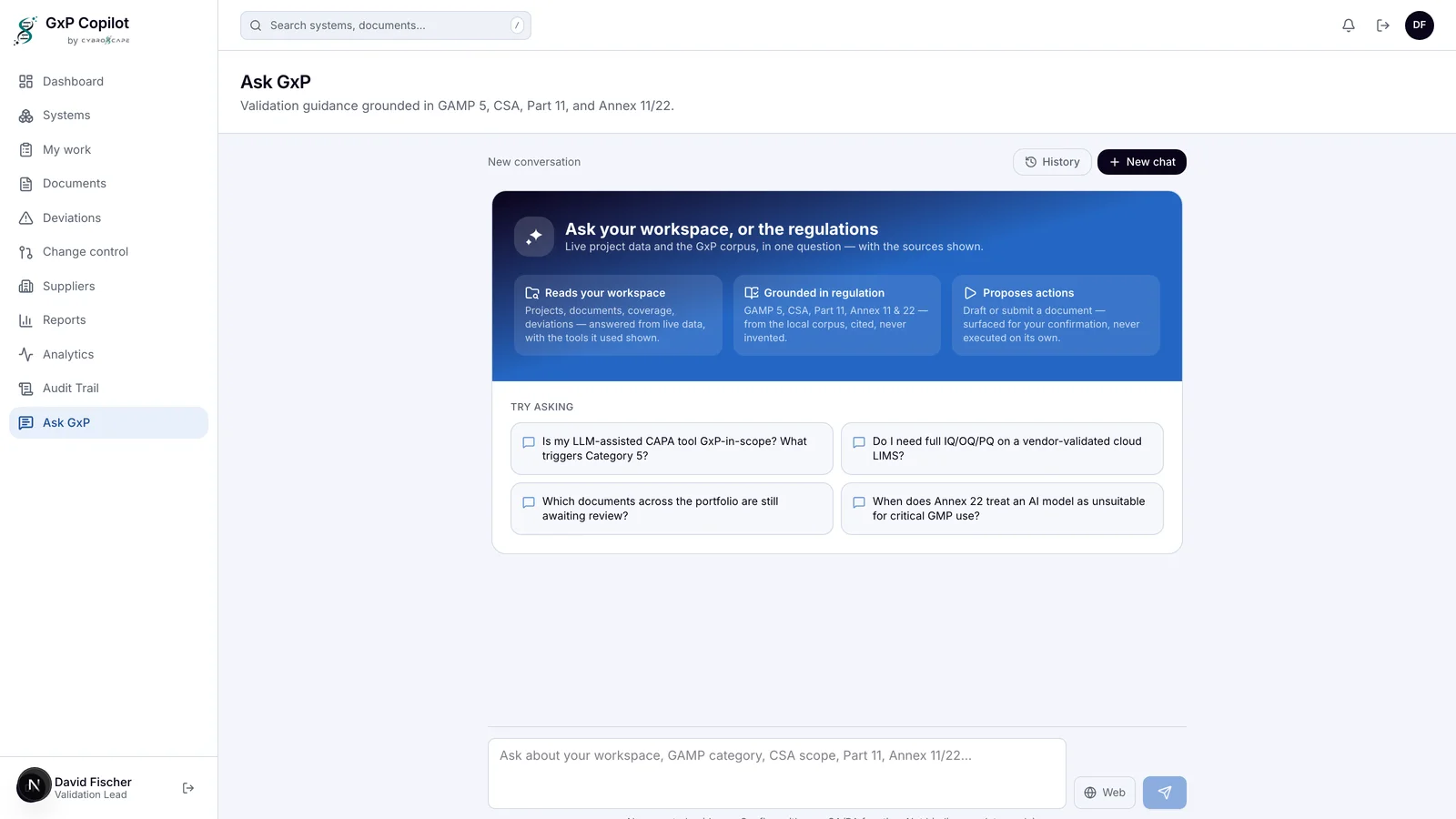
Real screenshots — the built-in document engine, the tamper-evident audit trail, and an assistant that already knows your regulatory context.
How GxP Copilot runs the validation lifecycle
Six stages, three human-review gates, one audit trail. Select a stage to see what happens in it.
A requirement register with an ID for every requirement.
Your validation lead confirms the requirements and which ones are GxP-relevant.
The GxP Copilot capability stack
Every capability has its own page, written for search and generative engines alike. Pick one to see how it works.
A guided intake — accelerated by AI, decided by your team — produces GxP impact, GAMP category and composite risk, along with the exact reasoning behind each result. Instead of week-long assessments, you get a classification you can defend to an inspector on the same day. The AI accelerates the input; the classification itself is transparent and controlled.
Learn more about AI Classification EngineRight deliverables, right depthRisk-Based Validation ScopingThe Strategy Engine picks the applicable deliverable set for each GAMP category and scales test rigor to per-requirement risk under CSA — choosing between scripted testing, unscripted verification, and leveraged supplier evidence. The output is a validation plan sized to reality, easy to defend, and quick to execute.
Learn more about Risk-Based Validation ScopingRisk that changes what you testAI Risk AssessmentEvery requirement is scored against an ICH Q9 lens for severity, probability and detectability. That score drives the test strategy, the traceability coverage and the inspection-readiness view — so risk stops being a compliance formality and starts sizing your actual work.
Learn more about AI Risk AssessmentEvery artifact, canonical and provableDocument Control & VersioningEvery document version is fingerprinted and tagged with its provenance and any AI assistance used. Data-driven sections stay canonical across every deliverable — so what you sign is what you keep, and what you keep is what you show an auditor.
Learn more about Document Control & VersioningYour templates, drafted in minutesAI Validation Document DraftingThe Documentation Engine drafts your validation deliverables in the style of the templates your organisation already uses — with confidence checks, review gates, and a fully functional fallback when the AI is unavailable. Your team stays in control; the platform removes the drudge work.
Learn more about AI Validation Document DraftingDerived, not maintainedLive Traceability MatrixThe Live RTM is always up to date — coverage gaps, orphan tests and inspection-readiness are computed on the fly from the links between requirements, design, tests and results. No more spreadsheet upkeep, no more RTM-freshness debates before an audit.
Learn more about Live Traceability MatrixProtocols shaped by real riskAI Test Case GenerationInstallation, Operational and Performance Qualification protocols are drafted from your requirements and design, right-sized by the risk engine, and structured for straightforward execution. Effort follows risk — high risk is scripted with an independent witness, medium is scripted or hybrid, and low risk can be unscripted with supplier evidence.
Learn more about AI Test Case GenerationMobile execution cockpitTesting ManagementA mobile-friendly execution experience for the people actually running the tests. Step verdicts, photo and file evidence, and any deviation that opens along the way flow straight into the record and up to the traceability view — no double-entry, no lost paperwork.
Learn more about Testing ManagementImmutable, always traceableChange ControlsChange controls sit alongside deviations and periodic reviews as first-class records. Signed versions stay frozen; corrections roll forward as new versions with their own approval cycle. You always know what changed, why, and who signed it off.
Learn more about Change ControlsValidates its own AIAI Validation (Annex 22)An EU Annex 22 assurance layer publishes how the platform's AI is governed — the boundaries of its use, the human-in-the-loop policy, the safeguards on its outputs, and the fallback that keeps your workflow running when the AI is unavailable. If regulators ask, the answer is already published.
Learn more about AI Validation (Annex 22)AI drafts, humans decideHuman-in-the-Loop ReviewsReviewers and approvers are assigned; sign-off requires the number of people your SOP demands; and an author can never approve their own draft. AI accelerates the writing; humans make the calls that count — and the workflow makes it hard to skip a step.
Learn more about Human-in-the-Loop ReviewsAlways inspectableAudit ReadinessEvery action is captured in a tamper-evident audit trail with an integrity check that flags any change. Combined with the live traceability view and coverage detection, you have an always-on inspection posture — no fire-drill needed the week an auditor lands.
Learn more about Audit ReadinessLeverage what your vendor already provedSupplier QualificationSupplier qualification is treated as a genuine test strategy — with vendor-supplied evidence stored, reviewed and linked to the traceability view. That matches the FDA CSA principle of least-burdensome effort and cuts scripted-test work on non-configured commercial software.
Learn more about Supplier QualificationOne requirement, one storyRequirement MappingRequirements carry their functional risk assessment and connect end-to-end to design, test cases, executions and evidence. Requirements can be imported from your existing ticket tools so your engineering and validation teams are looking at the same source of truth.
Learn more about Requirement MappingProtocols → execution → reportIQ / OQ / PQ ManagementInstallation, Operational and Performance Qualification protocols draft from your intake, execute in a mobile-friendly cockpit, and roll up into a Validation Summary Report. Step verdicts, evidence and deviations flow into the record without hand-typing.
Learn more about IQ / OQ / PQ ManagementRisk-based, least-burdensomeCSA ValidationBuilt CSA-first: real per-requirement risk drives the test strategy, not the category label alone. You get a defensible reduction in low-value scripted testing and a validation posture that matches the direction the FDA is signalling.
Learn more about CSA ValidationFull V-model, end-to-endCSV ValidationThe full V-model — Validation Plan, URS, Functional Risk Assessment, Design Spec, IQ/OQ/PQ protocols and reports, Requirement Traceability Matrix and Validation Summary Report — generated end-to-end. GAMP 5 Second Edition aligned, extensible for your governance additions.
Learn more about CSV ValidationReal e-signatures, not just checkboxesFDA 21 CFR Part 11 ComplianceElectronic signatures require the ceremony 21 CFR Part 11 demands — including re-authentication, meaning, name, timestamp and content binding. Authors cannot approve their own drafts. Signed versions cannot be silently edited. Regulators get real Part 11 posture, not checkbox posture.
Learn more about FDA 21 CFR Part 11 ComplianceArchitected, not retrofittedEU Annex 11 & Annex 22 ComplianceEU Annex 11 requirements — controlled documents, electronic signatures, audit trails, change control, periodic review and retirement — are covered by the platform's document lifecycle. The Annex 22 assurance stack is architected in, so the AI-in-GMP conversation with EU regulators is one you can have today.
Learn more about EU Annex 11 & Annex 22 ComplianceCompare GxP Copilot
Honest comparisons with the platforms you are likely weighing, including where each of them is the better choice.
Side by side with the platforms teams most often shortlist.
When the platform you have does not fit your team.
Independent head-to-heads and the questions that decide a shortlist.
21 CFR Part 11, EU Annex 11, and EU Annex 22 — Built In, Not Bolted On
21 CFR Part 11 compliance in GxP Copilot is not a feature flag or an add-on module. The electronic signature ceremony is enforced at the data layer: signing requires re-authentication (password or equivalent second factor), records the signer's name, the date and time, and the meaning of the signature, and binds the signature cryptographically to the content being signed. Once a document version is signed, it is frozen — no silent edit is possible. Authors cannot approve their own drafts. The workflow enforces segregation of duties by configuration, not by policy alone. The audit trail is tamper-evident, append-only, and verified on read with an integrity check that surfaces any modification attempt.
EU Annex 11 requirements — controlled document lifecycle from draft through retirement, first-class electronic records, change controls with impact assessment, and periodic review scheduling — are covered across the platform's document and workflow layer. The draft EU GMP Annex 22 (AI in GMP), still a consultation draft, sets out the direction for AI used within GxP environments. GxP Copilot's own AI governance is built with it in mind: the assurance documentation is published, the boundaries of AI use are explicit, and the workflow keeps running without AI dependency. This means you start with the governance of your validation tool's AI documented, rather than having to work it out yourself.
Copilot
Full validation package for a LIMS deployment in 4 weeks
A Series-B biotech deploying its first regulated LIMS had eight weeks before go-live and no QA function.
Read the case studyEverything a validation lead asks before buying
What Computer System Validation Actually Requires in 2026
Computer System Validation (CSV) under GAMP 5 Second Edition is a risk-based, lifecycle process that produces documented evidence a system consistently does what it is intended to do. For any system classified as GxP-impacting — meaning it creates, modifies, maintains, archives, retrieves, or transmits data that supports a regulatory decision — validation is not optional and not a one-time event. It spans the system's entire operational life: from initial specification through change control, periodic review, and eventual retirement.
FDA's Computer Software Assurance (CSA) guidance, issued in draft in 2022, finalised in September 2025 and reissued in February 2026, updated how regulators expect that effort to be distributed. The core shift is from maximum documentation to critical thinking: test effort should scale to per-requirement risk, not to GAMP category alone, and organisations should leverage supplier documentation wherever a qualified vendor has already produced it. This means a LIMS deployment from a well-documented vendor can defensibly carry less scripted-test effort than a custom in-house system — but the risk assessment, the traceability, and the audit trail remain non-negotiable regardless of the approach chosen.
GxP Copilot is built around this regulatory evolution. It does not produce a maximalist documentation package for its own sake. It produces the right package — right depth, right deliverables, right traceability — sized to the actual per-requirement risk of the system you are validating, under both GAMP 5 Second Edition and FDA CSA guidance.
The Systems GxP Copilot Can Validate
GxP Copilot is system-agnostic. The intake questions drive the classification and risk scoring regardless of whether the target system is a commercial off-the-shelf solution, a configured ERP module, a custom-built in-house application, or a cloud-hosted SaaS platform. Regulated life sciences teams use GxP Copilot to validate LIMS (LabWare, LabVantage, STARLIMS, SampleManager, Benchling), Laboratory Execution Systems, Manufacturing Execution Systems (Werum PAS-X, Körber, Opcenter, Rockwell FactoryTalk), SCADA and DCS platforms (DeltaV, Ignition, Experion, Siemens PCS7), ERP financial and supply-chain modules (SAP ECC, S/4HANA, Oracle EBS, Oracle Cloud), eQMS, RIM, pharmacovigilance systems, and custom software built on internal stacks.
The GAMP 5 category produced by the Classification Engine drives the applicable deliverable set and the default test strategy. Category 3 (non-configured commercial software) typically draws a lighter OQ path with strong supplier documentation leverage. Category 4 (configured) triggers a full IQ/OQ/PQ structure with configuration traceability. Category 5 (custom) carries the heaviest package including functional specification, design verification, and comprehensive test coverage. In all cases risk scoring ensures that individual test effort within each protocol reflects the functional risk of that specific requirement — so a low-risk administrative function does not absorb the same effort as a data-integrity-critical calculation.
How GxP Copilot's AI Works — and Where Humans Stay in Control
GxP Copilot uses AI to accelerate the parts of validation that are genuinely mechanical: synthesising an intake into a GAMP classification, drafting structured deliverable text from templates, generating test cases from requirements and design specifications, flagging coverage gaps in the traceability matrix. These tasks are time-consuming when done manually, but they are not where a validation lead's judgment is most needed. The platform takes the drafting burden off the team so that expert time is spent on the decisions that matter — reviewing risk scores, approving test strategies, catching gaps, and signing off.
Every AI action is bounded by deterministic safeguards. The classification engine produces a structured output with explicit reasoning that a reviewer can interrogate line by line. Deliverables are drafted against your organisation's own templates, and none becomes final without passing a human review gate. Generated protocols arrive in a format your team edits, executes, and signs — not a black box output accepted without review. And the entire AI behaviour is governed by a published EU Annex 22 assurance layer: model governance, human-in-the-loop policy, safeguards on AI output, and a fully functional fallback for every workflow when AI is unavailable. If regulators ask how the AI is governed, the answer is already documented.
- Signer’s name
- Date and time
- Meaning of the signature
- Entry in the audit trail
GxP Copilot and the Established Validation Platforms: What Differs
ValGenesis, Veeva Vault Validation Management, Kneat and MasterControl are established platforms with long track records, deep configuration and strong Part 11 controls. All of them are adding AI. ValGenesis relaunched its VAL assistant in April 2026 for protocol and trace generation, gap assessment and execution review, initially as a pilot. Kneat's 26R2 release added AI for validation summary reports and a regulatory question-answering assistant. Veeva has been rolling out AI agents across Vault since late 2025. MasterControl's Validation Excellence Tool helps customers keep MasterControl itself validated, and its 2026 AI features include an SOP Analyzer and an Event Summarizer.
GxP Copilot starts from a different place. It was built around drafting: a deterministic, explainable classification, AI-drafted deliverables that qualified people review and approve, per-requirement risk that sets test rigour, and a traceability matrix derived live from the records. It is designed for mid-sized teams such as Series A to C biotech, CDMOs, medical-device companies and CROs, runs as SaaS without a professional-services dependency to go live, and is priced for that segment. It is newer than the established platforms, with a much smaller installed base, so test it on one of your own systems alongside them.
| Established platforms | GxP Copilot | |
|---|---|---|
| Starting point | Controlled workflow and configuration, now adding AI | Drafting the package for you |
| Risk and classification | Configured to each customer's method | Deterministic and explained per requirement |
| Track record | Long, with large installed bases | Newer, smaller installed base |
| Best fit | Organisations with validation departments | Mid-sized teams without a large one |
The Live Requirement Traceability Matrix — Always Current, Never Maintained
The Requirement Traceability Matrix (RTM) is the single most-scrutinised document in a GxP system audit after the validation summary report. Inspectors use it to confirm that every user requirement has a corresponding design specification, a corresponding test case, a test execution result, and — where applicable — deviation resolution. A static RTM maintained in a spreadsheet is almost always out of date by the time an auditor sees it: test cases are added during execution, requirements evolve, deviations get resolved and the matrix never fully catches up.
GxP Copilot's Live RTM is derived, not maintained. Coverage, gaps, orphan tests, and the inspection-readiness verdict are computed on the fly from the live links between requirements, design specifications, test cases, executions, and evidence. When a test case is added, the RTM reflects it immediately. When a deviation is resolved, the RTM reflects that. When a requirement changes under change control, the RTM flags the tests that now require re-execution. There is no separate RTM document to update — the matrix is the live state of the validation record, available to export to PDF or CSV at any moment, always accurate for the moment it is exported.
Deployment Models, Data Residency, and Security
GxP Copilot is available as a cloud-hosted multi-tenant SaaS for the majority of customers, with tenant isolation enforced at the data layer and role-based access control with segregation of duties across all compliance-critical actions. For regulated deployments with specific data-residency requirements — EU GDPR-constrained environments, US federal contractors, or customers operating under clinical trial agreements with specific data localisation clauses — single-tenant and private-cloud options are available. Self-hosted deployment for customers who must maintain their own infrastructure is scoped on request.
The platform is built to the same security standards it helps customers validate: access is audited, sessions are tracked, API access is controlled with scoped keys, and the system's own configuration and code base go through change control. Customers receive a vendor audit package on request that documents the platform's own validation posture — including its GAMP 5 classification, its own IQ/OQ/PQ records, and its EU Annex 22 assurance documentation. This is the documentation a regulated customer needs to qualify GxP Copilot as a supplier under their own supplier qualification programme.
Getting to Your First Inspection-Ready Package
Because the drafting is done for you, a first end-to-end draft of the validation package can be produced within the first few days of active use. The intake for a new project is a short questionnaire plus your requirements. The Classification Engine produces a GAMP category and risk profile with its reasoning exposed. From there the platform scopes the applicable deliverable set and the default test approach. Each deliverable is then drafted in your organisation's template style. Your validation leads review, refine, and fill judgment-dependent gaps — functional risk commentary, rationale for test depth decisions, any system-specific context the intake did not capture.
The sign-off cycle, the reviewer and approver actions that take a draft from 'in review' to 'approved' with a 21 CFR Part 11 electronic signature, then runs at the pace of your reviewers. The Validation Summary Report is assembled automatically from the signed deliverables and execution results. You exit the project with an inspection-ready package that a regulator can audit end-to-end: requirements to risk to test strategy to executed tests to evidence to deviations to sign-off. No separate remediation project is needed to make the record auditable — it is auditable from the moment it is built.
- Validation planFor review
- Risk assessmentFor review
- IQ / OQ / PQ protocolsFor review
- Traceability matrixFor review
- Validation summary reportFor review
Sources
Primary documents referred to on this page, from their official publishers.
- 21 CFR Part 11: Electronic Records; Electronic Signatures · eCFR (US)
- Computer Software Assurance for Production and Quality Management System Software (final guidance, February 2026) · US FDA
- EudraLex Volume 4: EU Good Manufacturing Practice guidelines · European Commission
- EU GMP Annex 11: Computerised Systems (current version) · European Commission
- Consultation on EU GMP Chapter 4, Annex 11 and draft Annex 22 (Artificial Intelligence) · European Commission
- ISPE GAMP 5 Guide, Second Edition · ISPE
Product plus the team that runs it
GxP Copilot FAQs
The questions we get before every first call, answered plainly. Prefer to talk first? Chat with us on WhatsApp.
How does GxP Copilot compare to legacy validation platforms?
GxP Copilot starts from drafting: it drafts the GAMP 5 Second Edition validation package for your team to review and approve, sets test effort from per-requirement risk, keeps traceability current and includes AI governance for its own AI. The established platforms are strong, configurable products with long track records and are adding AI as well; GxP Copilot is newer and aimed at mid-sized teams. The fair comparison is to run each on one of your own systems.
Is GxP Copilot 21 CFR Part 11 compliant?
Yes. Electronic signatures include the ceremony 21 CFR Part 11 demands — re-authentication at signing, meaning, name, timestamp and content binding. Authors cannot approve their own drafts. The audit trail is tamper-evident with an integrity check that flags any change, and signed versions cannot be silently edited.
Does it support EU Annex 11 and Annex 22?
Yes for Annex 11: the full document lifecycle (draft through retirement), tamper-evident audit trail, first-class change controls and periodic reviews cover it today. Annex 22 is still a consultation draft; GxP Copilot's AI governance — published AI governance, safeguards, human-in-the-loop policy and a documented fallback — is built with it in mind, not bolted on later.
What's the deployment model?
Cloud-hosted multi-tenant SaaS for most customers; single-tenant and self-hosted options for regulated deployments where required.
Which systems can GxP Copilot help validate?
ERP and finance systems (SAP, Oracle), LIMS (LabWare, LabVantage, STARLIMS, SampleManager, Benchling), MES (Werum PAS-X, Opcenter, Rockwell, Körber), SCADA / DCS (DeltaV, Ignition, Experion), eQMS, RIM — and custom in-house systems.
How quickly can we see a complete validation package?
Because the drafting is done for you, a first end-to-end draft package can be ready within the first few days of use. How long sign-off takes depends on your scope and how quickly your reviewers work; your validation leads own the review, and the platform handles the drafting and evidence assembly.
See GxP Copilot run on your own data.
One real requirements document. We show you the draft package built from it, and you keep it either way.
- We reply within one business day
- We run your URS live on the call
- You get a clear plan for your system