The AI in the platform is validated the same way the platform validates yours.
An EU Annex 22 assurance layer publishes how the platform's AI is governed — the boundaries of its use, the human-in-the-loop policy, the safeguards on its outputs, and the fallback that keeps your workflow running when the AI is unavailable. If regulators ask, the answer is already published.
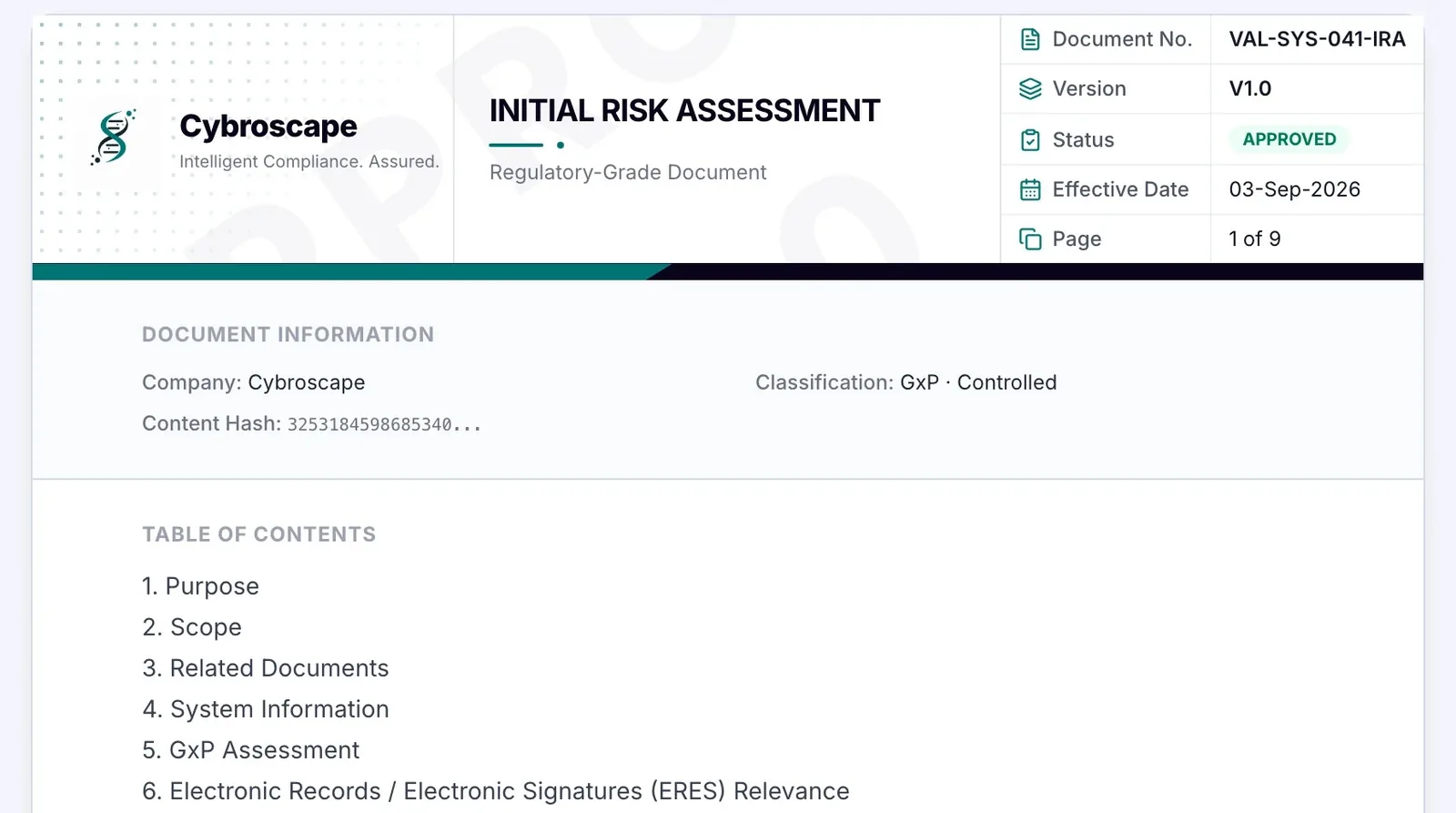
Validating an AI system means proving it is fit for a bounded intended use and keeping it that way as the model changes. GxP Copilot supports that lifecycle — intended use, evaluation against held-out data, human decision on anything consequential, drift monitoring, model change control and a documented fallback — and applies the same discipline to its own AI.
Software that can get worse without anyone changing it
Conventional validation rests on an assumption that does not hold for AI: that an unchanged system behaves consistently. A model whose inputs gradually drift away from what it was evaluated against degrades while every configuration setting stays exactly as approved.
The second difficulty is scope. An AI feature arrives as an update to software you already validated, nobody classifies it as an AI project, and it is in production before anyone assesses it.
The third is the vendor who changes the underlying model without telling you. Your validated state depended on behaviour you no longer control.
Bounded use and a gate that holds
An intended use statement that names what the system does, on what inputs, for which decision — and explicitly what it must not be used for, so scope creep after go-live is visible rather than gradual.
Performance is demonstrated against data held out from training, with thresholds set before the evaluation rather than chosen after seeing results. A release that fails the gate does not ship.
The human line, drawn and kept
Classification, risk and release are computed from confirmed facts, never generated. Approval is a Part 11 signature by a named, re-authenticated person. The AI drafts, retrieves and proposes; it does not decide.
The draft EU Annex 22 expects a qualified person to remain accountable for decisions affecting product quality or patient safety. That is not a constraint we work around — it is the condition that makes AI acceptable in this workflow at all.
Monitoring, change control and a way back
Drift is monitored, model versions are pinned and recorded, and model changes — retraining, tuning, a vendor upgrade — go through change control like any other change to a validated system.
There is a documented fallback: the process continues with the AI disabled. Without AI drafting, document generation still runs from templates, which means the fallback is a working mode rather than a paragraph in a plan.
What you get
What AI Validation (Annex 22) delivers
AI Validation (Annex 22) is part of the GxP Copilot platform — an AI-native, CSA-first validation system built for regulated Life Sciences. See how it fits with AI Classification Engine, Risk-Based Validation Scoping, AI Risk Assessment.
- Published AI governance for the platform itself
- Deterministic safeguards on every AI output
- Human-in-the-loop enforced at critical steps
- Workflow keeps running with the AI switched off
Common questions
Prefer to talk first? Chat with us on WhatsApp or book a call with an expert.
How is validating AI different from validating software?
Conventional validation assumes an unchanged system behaves consistently. A model can degrade while every setting stays as approved, because live inputs drift away from the data it was evaluated against. That is why AI validation adds production monitoring, periodic re-evaluation and a documented fallback to the usual lifecycle.
What does the draft EU Annex 22 require?
Annex 22 is a draft — consultation closed in October 2025 and it has not been adopted. It sets out a bounded intended use, performance against data independent of training, human accountability for GMP-critical decisions, explainability proportionate to risk, drift monitoring, model change control and a documented fallback.
What happens if we turn the AI off?
The platform keeps working. Without AI drafting it runs in template mode — the full lifecycle, documents, execution, signatures and traceability all function; the drafts simply start from templates rather than from generated text. The fallback is a mode you can operate in, not a contingency described in a plan.
Related capabilities
All capabilitiesA guided intake — accelerated by AI, decided by your team — produces GxP impact, GAMP category and composite risk, along with the exact reasoning behind each result. Instead of week-long assessments, you get a classification you can defend to an inspector on the same day. The AI accelerates the input; the classification itself is transparent and controlled.
Learn more about AI Classification EngineRisk-Based Validation ScopingThe Strategy Engine picks the applicable deliverable set for each GAMP category and scales test rigor to per-requirement risk under CSA — choosing between scripted testing, unscripted verification, and leveraged supplier evidence. The output is a validation plan sized to reality, easy to defend, and quick to execute.
Learn more about Risk-Based Validation ScopingAI Risk AssessmentEvery requirement is scored against an ICH Q9 lens for severity, probability and detectability. That score drives the test strategy, the traceability coverage and the inspection-readiness view — so risk stops being a compliance formality and starts sizing your actual work.
Learn more about AI Risk AssessmentDocument Control & VersioningEvery document version is fingerprinted and tagged with its provenance and any AI assistance used. Data-driven sections stay canonical across every deliverable — so what you sign is what you keep, and what you keep is what you show an auditor.
Learn more about Document Control & VersioningAI Validation Document DraftingThe Documentation Engine drafts your validation deliverables in the style of the templates your organisation already uses — with confidence checks, review gates, and a fully functional fallback when the AI is unavailable. Your team stays in control; the platform removes the drudge work.
Learn more about AI Validation Document DraftingLive Traceability MatrixThe Live RTM is always up to date — coverage gaps, orphan tests and inspection-readiness are computed on the fly from the links between requirements, design, tests and results. No more spreadsheet upkeep, no more RTM-freshness debates before an audit.
Learn more about Live Traceability MatrixSources
Primary documents referred to on this page, from their official publishers.
See validation (annex 22) on your own requirements.
One real requirements document. We show you the draft package built from it, and you keep it either way.
- We reply within one business day
- We run your URS live on the call
- You get a clear plan for your system