Validation & Compliance Services
End-to-end computer system validation done the CSA way — risk-based, least-burdensome, AI-accelerated where it helps and human-owned where it must be. From URS to VSR, from IQ to periodic review, delivered by validation leads who have shipped inspection-ready systems in FDA, EMA, MHRA, PMDA and CDSCO regulated environments.
Computer system validation is the documented evidence that a GxP system does what it is supposed to do, reproducibly, and that an inspector can follow the proof. It covers requirements, risk assessment, IQ/OQ/PQ testing, traceability and a summary report. Under FDA's Computer Software Assurance guidance, how much you test each requirement depends on what happens if it fails.
Every validation & compliance discipline we deliver
Each one has its own page with scope, deliverables and timelines.
Who needs computer system validation
If a system creates, changes, stores or decides anything that affects product quality, patient safety or the integrity of regulated data, it needs validating. In practice that means LIMS, MES, SCADA, eQMS, ERP modules that touch batch records, chromatography data systems, clinical databases, and increasingly the AI tools sitting on top of them.
The trigger is usually one of four things: a new system going live, an inspection finding, a vendor upgrade that broke validated status, or an acquisition that brought an unvalidated estate with it. The right scope looks different in each case, which is why we start by asking which one you are in rather than quoting a package.
CSV and CSA are not competing methods
Computer System Validation is the activity. Computer Software Assurance is FDA's guidance on how to size it, finalised in September 2025. CSA does not replace CSV and it does not mean less evidence — it means the evidence is concentrated where failure actually matters, and reduced where a supplier has already tested something adequately.
The practical difference shows up in the test plan. Under a traditional approach every requirement gets a scripted script with screenshots. Under CSA, a high-risk requirement still gets that, a medium-risk one may be covered by unscripted testing with a session record, and a low-risk one may lean on the vendor's own testing. What makes it defensible is not the reduction — it is the written rationale for each decision.
What you actually receive
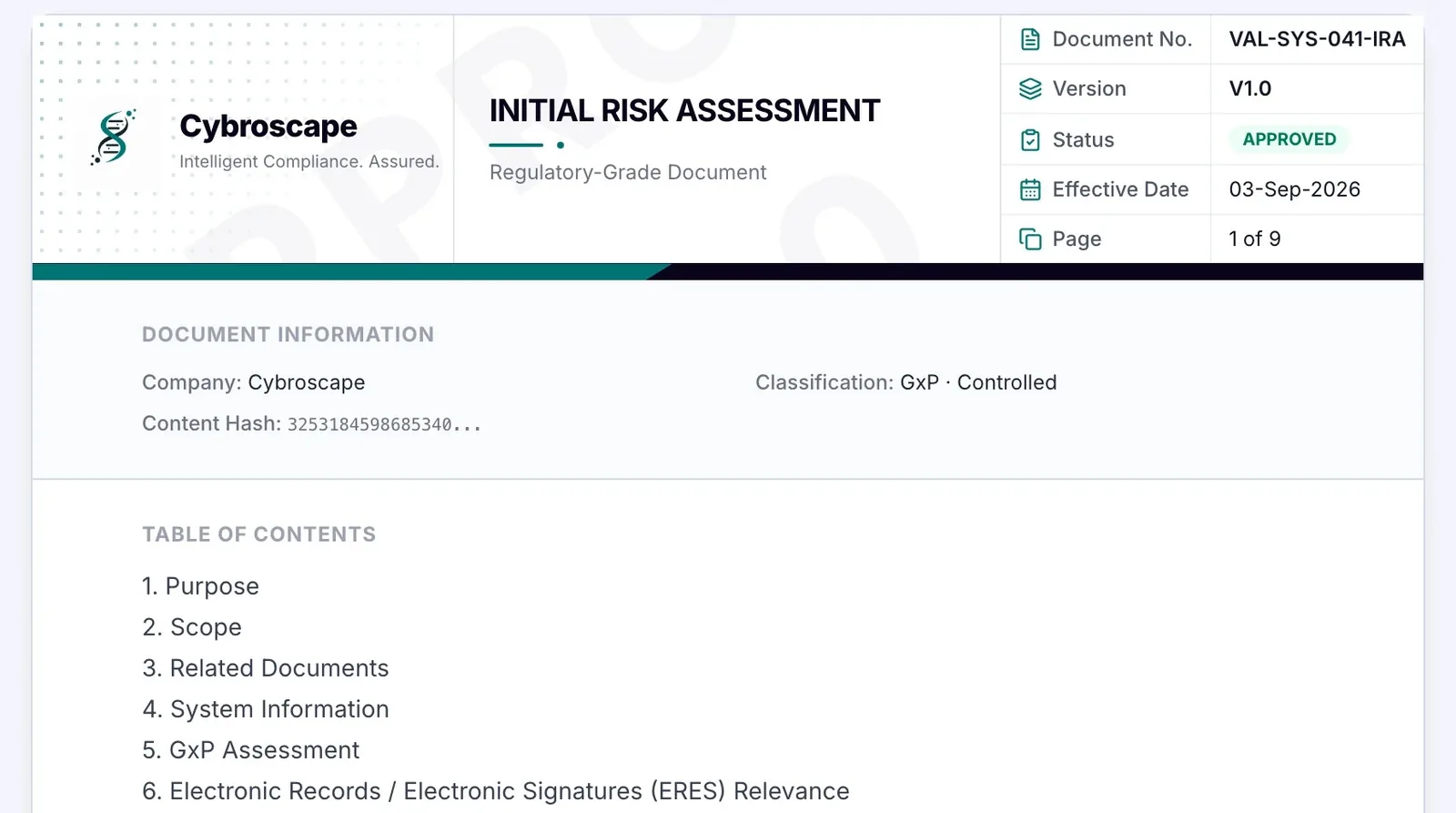
A validation package is a set of controlled, signed documents, not a report. Typically: a Validation Master Plan, User Requirement Specification, a functional risk assessment scoring every requirement, IQ, OQ and PQ protocols, the executed protocols with evidence attached, a deviation log with each item closed, a Requirements Traceability Matrix, and a Validation Summary Report.
Two things separate a package that survives inspection from one that does not. Every test must trace back to a numbered requirement, and every deviation must have a documented resolution rather than a note saying it was accepted. Inspectors tend to pull on exactly those two threads.
How long it takes, honestly
A conventional CSV project on a configured system of moderate complexity runs several months, and the bottleneck is almost never the thinking — it is drafting and formatting structured documents that follow predictable patterns.
That is the part we compress with GxP Copilot: the first complete draft of the deliverable set is generated from your system description, and your validation lead spends their time reviewing and deciding rather than assembling. The review, approval and signature steps still take the time they take, because a human still has to own them.
Drafting, tests, traceability and report generated in one pass, then reviewed.
Illustrative comparison. Real time depends on system size, scope and how quickly your reviewers turn work around.
Validation does not end at go-live
A system is validated as at a point in time. Every configuration change, software update, new user role or changed business process can take it out of that state. The two things that keep it in: a change control process that assesses regulatory impact before the change ships, and a periodic review that looks at the change history, incidents and current regulatory expectations.
Periodic review is the single most commonly skipped Annex 11 obligation we encounter. It is not a revalidation — it is a structured check that the system is still what the documentation says it is.
Where AI fits, and where it does not
AI drafts. Qualified people decide and sign. Classification and risk scoring are computed deterministically rather than generated, because an inspector will ask how a number was arrived at and "the model produced it" is not an answer.
EU Annex 22 — still a draft, but the clearest signal available — sets out what regulators are expected to look for when AI is used in a GMP context: defined intended use, an evaluation set that gates releases, human oversight on anything consequential, monitoring for drift, and a fallback so the process still runs with the AI switched off. We build to that standard whether or not you are using our software.
SAP S/4HANA validation for a mid-market oral-solid-dose manufacturer
A CSA-native validation of SAP S/4HANA batch management, QM and materials — delivered against a fixed 12-week inspection window, with a defensible reduction in scripted-test effort and a live traceability view standing at go-live.
Read the case studyCommon questions
Prefer to talk first? Chat with us on WhatsApp or book a call with an expert.
What is the difference between CSV and CSA?
CSV is the validation activity itself — producing documented evidence that a GxP system works as intended. CSA is FDA's guidance on how to size that effort, finalised in September 2025, concentrating testing where failure would affect product quality, patient safety or data integrity, and reducing it elsewhere with a written rationale. CSA does not replace CSV.
Which systems need to be validated?
Any system that creates, modifies, stores or determines data affecting product quality, patient safety or data integrity. Commonly LIMS, MES, SCADA, eQMS, chromatography data systems, clinical databases, and ERP modules that touch batch or quality records. Infrastructure is usually qualified rather than validated.
What documents make up a validation package?
A Validation Master Plan, User Requirement Specification, functional risk assessment, IQ, OQ and PQ protocols and their executed records, a deviation log with documented resolutions, a Requirements Traceability Matrix, and a Validation Summary Report. The exact set scales with the system's GAMP 5 category and risk.
How long does a validation project take?
A conventional CSV project on a moderately complex configured system typically runs several months, with document authoring rather than decision-making as the bottleneck. Using GxP Copilot, the first complete draft of the deliverable set is produced in days; review, approval and signature still take the time a human needs to own them.
Does a validated system stay validated?
No. Validation is a point-in-time state. Software updates, configuration changes, new user roles and changed processes can all break it. Keeping validated status requires change control that assesses regulatory impact before a change ships, plus periodic review under EU GMP Annex 11.
How is AI validated under EU Annex 22?
Annex 22, still in draft, expects a defined intended use, an evaluation set that gates each release, human oversight of consequential decisions, monitoring for model drift, and a documented fallback so the process continues with the AI disabled. Risk and classification should be computed deterministically rather than generated, so each result can be explained to an inspector.
Get a validation scope you can defend.
A validation lead reviews your situation and proposes the smallest scope that does the job properly.
- We reply within one business day
- We look at your situation before we quote
- You get a clear plan and scope