Ready for the inspector who walks in unannounced.
Mock inspections, evidence-pack drills, RTM sanity, Part 11 posture — repeatable audit readiness, not a fire drill.
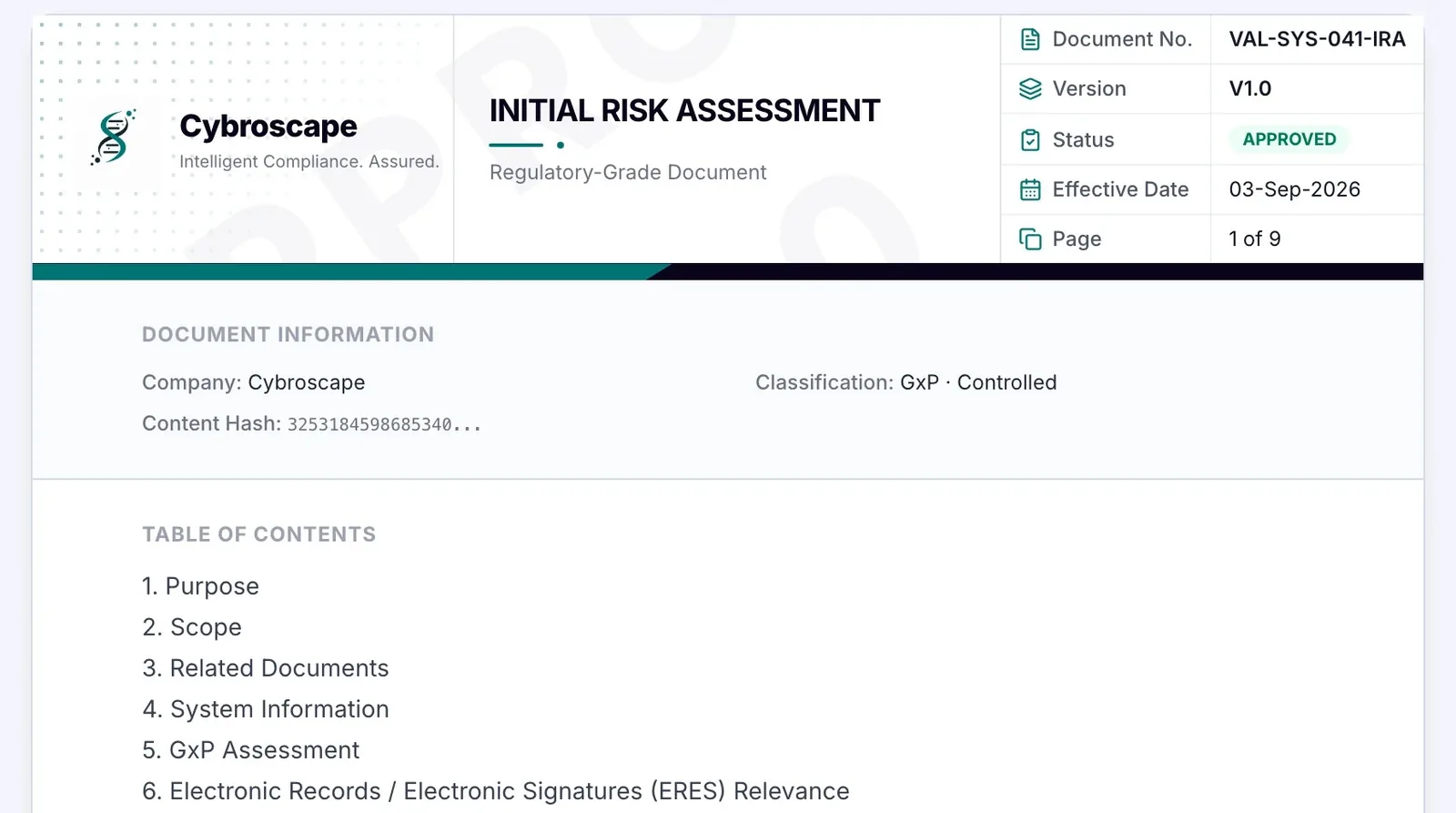
Audit readiness is the ability to produce complete evidence for any regulated system on demand — validation package, audit trail, change history, training records — in minutes rather than days. It is a retrieval capability tested by unannounced drill, not a documentation state assumed to be true, and the items that fail are usually lifecycle obligations rather than project deliverables.
Outcomes you can expect
- Mock inspection with findings
- Evidence-pack drill outcome
- Prioritised remediation
Audit Readiness is delivered by our validation & compliance services practice. Where it saves time, the team uses our products: GxP Copilot for validation lifecycle work and TraceDraft for clinical documentation.
Explore related capabilities: Computer System Validation (CSV), Computer Software Assurance (CSA), AI Validation Services (Annex 22), FDA 21 CFR Part 11 Compliance.
Audit Readiness Is a State, Not an Event
The most common mistake in GxP audit readiness is treating it as preparation for a specific upcoming inspection rather than a continuous operational state. Organisations that invest heavily in inspection preparation in the weeks before an announced FDA or MHRA inspection — and then resume normal operations after the inspector leaves — are not audit-ready. They have passed one inspection. Genuine audit readiness means that the evidence package for any system, any SOP, and any GxP record can be assembled quickly and presented coherently on any day the inspector chooses to arrive.
Building this state requires three capabilities: knowing what your evidence should show (the gap assessment), knowing what your evidence actually shows (the evidence-pack drill), and having a process for closing the gap between the two on a defined schedule (the remediation programme). Our audit readiness engagements deliver all three, working with your quality and validation teams to build the internal capability that makes inspection readiness sustainable rather than periodic.
Mock Inspections: The Most Useful Audit Readiness Tool
A mock inspection conducted by experienced GxP auditors is the most direct way to identify gaps before a regulatory inspector identifies them. Unlike a self-assessment, a mock inspection replicates the inspection dynamic: the lead auditor arrives with an inspection scenario, requests documentation without advance notice of the specific documents, interviews system owners and operators using the same techniques FDA and MHRA investigators use, and produces a findings report with the same classification structure as a real regulatory inspection.
Our mock inspections are conducted by consultants with direct experience of FDA PAI, MHRA site inspection, and EMA GCP inspection processes. The findings report classifies observations as critical, major, and other, with a CAPA plan template attached to each finding. The mock inspection report provides a concrete basis for prioritising audit readiness investments — directing resource toward the gaps that would generate critical or major observations rather than spreading effort uniformly across all compliance domains.
Evidence-Pack Drills and RTM Sanity Checks
An evidence-pack drill exercises the organisation's ability to locate, retrieve, and present the GxP evidence package for a specific system within a defined time limit. In a real inspection, the investigator may request the validation documentation for a LIMS or SCADA system within hours of arriving on site. If the evidence package exists but cannot be retrieved quickly, or if retrieved in a state that requires explanation rather than speaking for itself, the inspection will not go well regardless of the underlying compliance posture.
RTM sanity checks verify that the Requirements Traceability Matrix for each validated system actually traces correctly — that every URS requirement is covered by at least one test case, and that the referenced test cases are in the executed evidence package with passing results. RTM gaps are among the most commonly cited validation findings in FDA 483 observations because they are easy to detect (automated scan for untraced requirements or missing test cases) and indicate a systematic validation process weakness.
Sources
Primary documents referred to on this page, from their official publishers.
See it on your own system.
Bring a URS or a system. We show you the validation package it produces.
- We reply within one business day
- We run your URS live on the call
- You get a clear plan and scope