The complete V-model validation package — drafted, executed and reported.
The full V-model — Validation Plan, URS, Functional Risk Assessment, Design Spec, IQ/OQ/PQ protocols and reports, Requirement Traceability Matrix and Validation Summary Report — generated end-to-end. GAMP 5 Second Edition aligned, extensible for your governance additions.
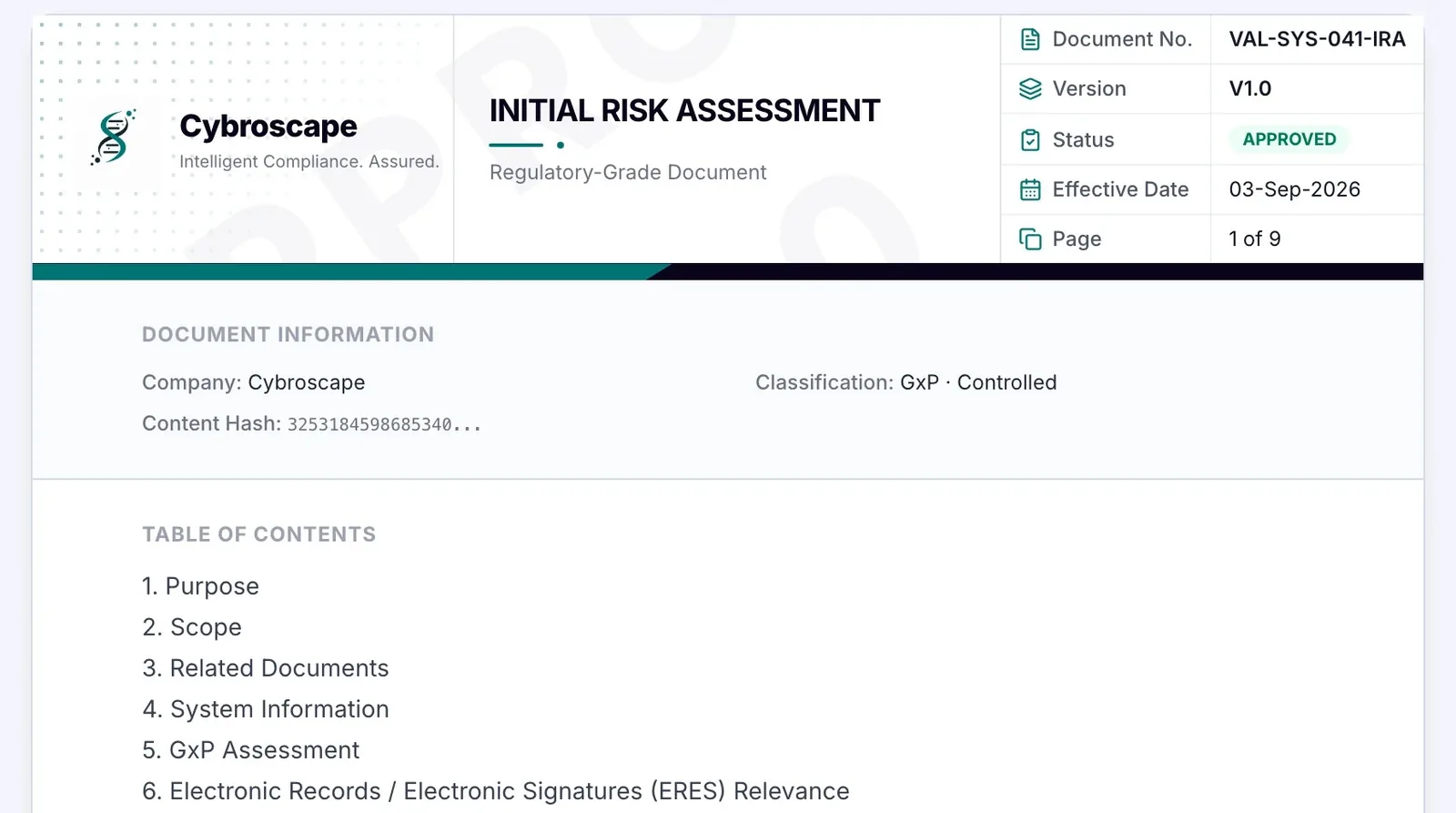
Computer system validation produces documented evidence that a GxP system does what it is supposed to do, reproducibly, with every test traceable to a requirement. GxP Copilot runs the full GAMP 5 lifecycle — plan, requirements, risk assessment, specifications, IQ/OQ/PQ, traceability and summary report — drafted by AI, decided and signed by qualified people.
A year of work, most of it typing
A conventional CSV project on a configured system of moderate complexity runs for months. Ask where the time went and it is not the regulatory judgement: it is drafting a URS from a vendor specification, writing protocols that follow a predictable structure, formatting evidence, and rebuilding a traceability matrix by hand each time a requirement moved.
That is why adding validation contractors produces a linear cost increase rather than a step change, and why skilled validation people spend most of their week on work that does not need their skill.
It is also why validation becomes the thing that delays go-live, which is how it acquires its reputation as an obstacle rather than an assurance.
The whole V-model from one intake
You provide the source material once. The platform produces the GxP and GAMP assessment, initial risk assessment, validation plan, URS with functional risk assessment, design and configuration specifications, IQ/OQ/PQ protocols and the validation summary report — each as a draft for review.
Classification is computed from confirmed facts rather than generated, so the document set you get is the one the system's category actually calls for, not a maximal template trimmed by hand.
Execution and evidence in the same place
Protocols are approved before execution and the order is enforced. Execution records verdicts step by step with evidence captured and sealed as it is taken, the executor and any witness recorded, and a Part 11 signature closing the record. Failures raise linked deviations with CAPA and effectiveness tracking.
The traceability matrix is a live view rather than a document rebuilt at the end, so coverage gaps surface while there is still time to close them.
Still validated next year
Change control assesses a proposed change against every approved baseline and revises only what it affects, preserving approved text everywhere else. Periodic review reports change history, incidents and performance on a schedule.
This is the part conventional projects leave to procedure, and it is where validated estates quietly stop being validated. Making it cheap is what makes it happen.
What you get
What CSV Validation delivers
CSV Validation is part of the GxP Copilot platform — an AI-native, CSA-first validation system built for regulated Life Sciences. See how it fits with AI Classification Engine, Risk-Based Validation Scoping, AI Risk Assessment.
- GAMP 5 Second Edition aligned
- Complete V-model plus governance
- Extensible to your organisation's additions
- One workspace, one traceable graph
Common questions
Prefer to talk first? Chat with us on WhatsApp or book a call with an expert.
What documents does a CSV package contain?
Typically a validation master plan and system-specific plan, system description, GxP and GAMP assessment, URS, functional risk assessment, functional and design or configuration specifications, IQ/OQ/PQ protocols and executed records, a deviation log, a requirements traceability matrix and a validation summary report. Which apply depends on the GAMP category.
How long does validation take with GxP Copilot?
The drafting that normally dominates the schedule is reduced to a review exercise. Review, approval and signature still take the time a human needs to own them, and execution takes as long as the testing takes. We do not publish a cycle-time figure because it depends heavily on system category, estate maturity and how quickly your approvers turn work around.
Does it work for systems validated outside the platform?
Yes. Approved documents can be brought in at their real version numbers and become controlled baselines, which is how revalidation of an existing estate works. A URS approved at v12.0 enters as v12.0 and its next revision is v12.1 rather than the system restarting your document history.
Related capabilities
All capabilitiesA guided intake — accelerated by AI, decided by your team — produces GxP impact, GAMP category and composite risk, along with the exact reasoning behind each result. Instead of week-long assessments, you get a classification you can defend to an inspector on the same day. The AI accelerates the input; the classification itself is transparent and controlled.
Learn more about AI Classification EngineRisk-Based Validation ScopingThe Strategy Engine picks the applicable deliverable set for each GAMP category and scales test rigor to per-requirement risk under CSA — choosing between scripted testing, unscripted verification, and leveraged supplier evidence. The output is a validation plan sized to reality, easy to defend, and quick to execute.
Learn more about Risk-Based Validation ScopingAI Risk AssessmentEvery requirement is scored against an ICH Q9 lens for severity, probability and detectability. That score drives the test strategy, the traceability coverage and the inspection-readiness view — so risk stops being a compliance formality and starts sizing your actual work.
Learn more about AI Risk AssessmentDocument Control & VersioningEvery document version is fingerprinted and tagged with its provenance and any AI assistance used. Data-driven sections stay canonical across every deliverable — so what you sign is what you keep, and what you keep is what you show an auditor.
Learn more about Document Control & VersioningAI Validation Document DraftingThe Documentation Engine drafts your validation deliverables in the style of the templates your organisation already uses — with confidence checks, review gates, and a fully functional fallback when the AI is unavailable. Your team stays in control; the platform removes the drudge work.
Learn more about AI Validation Document DraftingLive Traceability MatrixThe Live RTM is always up to date — coverage gaps, orphan tests and inspection-readiness are computed on the fly from the links between requirements, design, tests and results. No more spreadsheet upkeep, no more RTM-freshness debates before an audit.
Learn more about Live Traceability MatrixSources
Primary documents referred to on this page, from their official publishers.
See csv validation on your own requirements.
One real requirements document. We show you the draft package built from it, and you keep it either way.
- We reply within one business day
- We run your URS live on the call
- You get a clear plan for your system