Don't re-prove what a qualified supplier already proved.
Supplier qualification is treated as a genuine test strategy — with vendor-supplied evidence stored, reviewed and linked to the traceability view. That matches the FDA CSA principle of least-burdensome effort and cuts scripted-test work on non-configured commercial software.
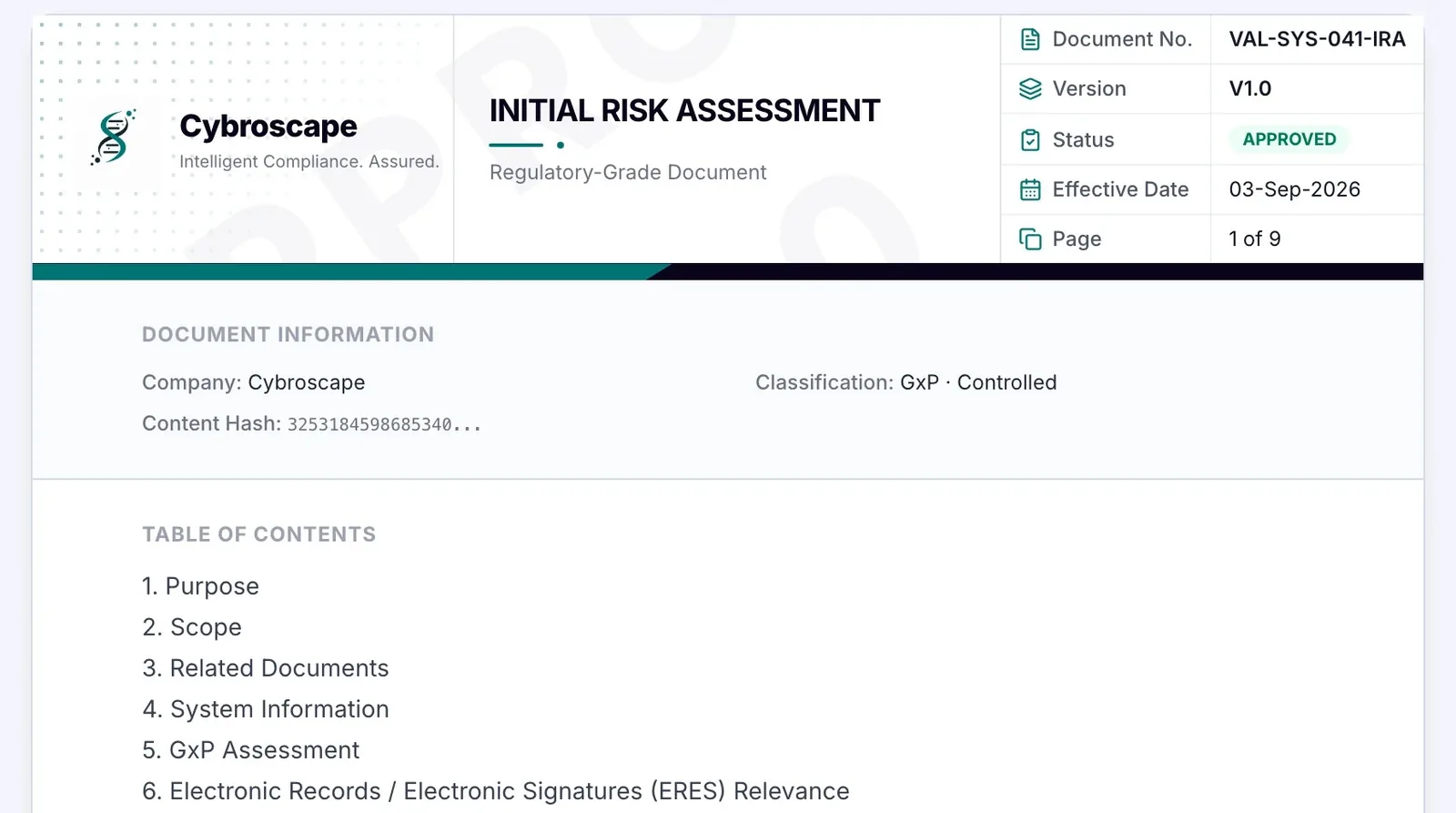
Supplier qualification establishes how much of a vendor's own evidence you can rely on instead of re-testing. GxP Copilot runs the assessment, records what you are relying on and why, and lets supplier-executed tests — a factory acceptance record, a vendor operational qualification — be reviewed and accepted against your requirements rather than repeated.
Paying twice for the same testing
A reputable vendor tests their product thoroughly and documents it. Most validation projects then test the same functionality again from scratch, because relying on supplier evidence requires a current supplier assessment and nobody has one.
The assessment feels like overhead — a questionnaire, a review, a file nobody reads. So it gets skipped, and the project pays for it in duplicated testing that is far more expensive than the assessment would have been.
The reverse failure also happens: relying on vendor evidence that was never assessed, which is the version that produces a finding rather than a saving.
Assessment that earns its keep
The assessment establishes what the supplier's quality system and development practice actually support, and — the part that matters — what specifically you intend to rely on as a result. A general statement that the vendor is reputable is not a basis for reducing testing; a specific statement that you are relying on their documented operational qualification for a named set of requirements is.
That specificity is what makes the reduction defensible when someone asks why a requirement was not tested directly.
- Validation planFor review
- Risk assessmentFor review
- IQ / OQ / PQ protocolsFor review
- Traceability matrixFor review
- Validation summary reportFor review
Supplier evidence used as evidence
Where you have the supplier's executed testing, it can be brought into the project, reviewed against the requirements it covers, and accepted — with the review and the acceptance decision recorded as part of the package. The requirement shows as covered by assessed supplier evidence rather than appearing as a gap or being quietly re-tested.
For instruments and equipment this is the normal case rather than the exception. Factory and site acceptance testing is performed by the supplier by design; the question is whether your package reflects that properly.
Assessments that stay current
An assessment is a point-in-time judgement about a supplier and a product. When either changes materially, or when your reliance on them increases, it needs revisiting. The platform tracks when each assessment was made and what it supports, so the dependency is visible rather than assumed to hold indefinitely.
What you get
What Supplier Qualification delivers
Supplier Qualification is part of the GxP Copilot platform — an AI-native, CSA-first validation system built for regulated Life Sciences. See how it fits with AI Classification Engine, Risk-Based Validation Scoping, AI Risk Assessment.
- Vendor evidence as a first-class test path
- Supplier assessment records
- Fast-path for non-configured commercial software
- Evidence linked to the traceability view
Common questions
Prefer to talk first? Chat with us on WhatsApp or book a call with an expert.
When can we rely on a supplier's testing instead of our own?
When you have a current supplier assessment that specifically states what you are relying on, and the supplier's evidence is detailed enough to cite against your requirements. A general view that the vendor is reputable is not a basis. Reliance without an assessment is a finding; reliance with one is a legitimate and substantial saving.
How do supplier tests appear in our validation package?
The supplier's executed testing is brought in, reviewed against the requirements it covers, and accepted — with the reviewer, the decision and the rationale recorded. The requirement shows as covered by assessed supplier evidence, so the traceability matrix is accurate rather than showing a gap or hiding a duplicate test.
How often should supplier assessments be refreshed?
When the supplier changes materially, when the product changes, or when your reliance on their evidence increases. The platform records when each assessment was made and what it supports, so an assessment quietly outliving its basis is visible rather than assumed to remain valid indefinitely.
Related capabilities
All capabilitiesA guided intake — accelerated by AI, decided by your team — produces GxP impact, GAMP category and composite risk, along with the exact reasoning behind each result. Instead of week-long assessments, you get a classification you can defend to an inspector on the same day. The AI accelerates the input; the classification itself is transparent and controlled.
Learn more about AI Classification EngineRisk-Based Validation ScopingThe Strategy Engine picks the applicable deliverable set for each GAMP category and scales test rigor to per-requirement risk under CSA — choosing between scripted testing, unscripted verification, and leveraged supplier evidence. The output is a validation plan sized to reality, easy to defend, and quick to execute.
Learn more about Risk-Based Validation ScopingAI Risk AssessmentEvery requirement is scored against an ICH Q9 lens for severity, probability and detectability. That score drives the test strategy, the traceability coverage and the inspection-readiness view — so risk stops being a compliance formality and starts sizing your actual work.
Learn more about AI Risk AssessmentDocument Control & VersioningEvery document version is fingerprinted and tagged with its provenance and any AI assistance used. Data-driven sections stay canonical across every deliverable — so what you sign is what you keep, and what you keep is what you show an auditor.
Learn more about Document Control & VersioningAI Validation Document DraftingThe Documentation Engine drafts your validation deliverables in the style of the templates your organisation already uses — with confidence checks, review gates, and a fully functional fallback when the AI is unavailable. Your team stays in control; the platform removes the drudge work.
Learn more about AI Validation Document DraftingLive Traceability MatrixThe Live RTM is always up to date — coverage gaps, orphan tests and inspection-readiness are computed on the fly from the links between requirements, design, tests and results. No more spreadsheet upkeep, no more RTM-freshness debates before an audit.
Learn more about Live Traceability MatrixSee supplier qualification on your own requirements.
One real requirements document. We show you the draft package built from it, and you keep it either way.
- We reply within one business day
- We run your URS live on the call
- You get a clear plan for your system