Long-running work runs in the background — the human review gate stays intact.
Generation, extraction and export run asynchronously so writers never wait for a spinner. Combined with the swappable AI provider, teams can automate draft production while keeping the human review gate exactly where it belongs.
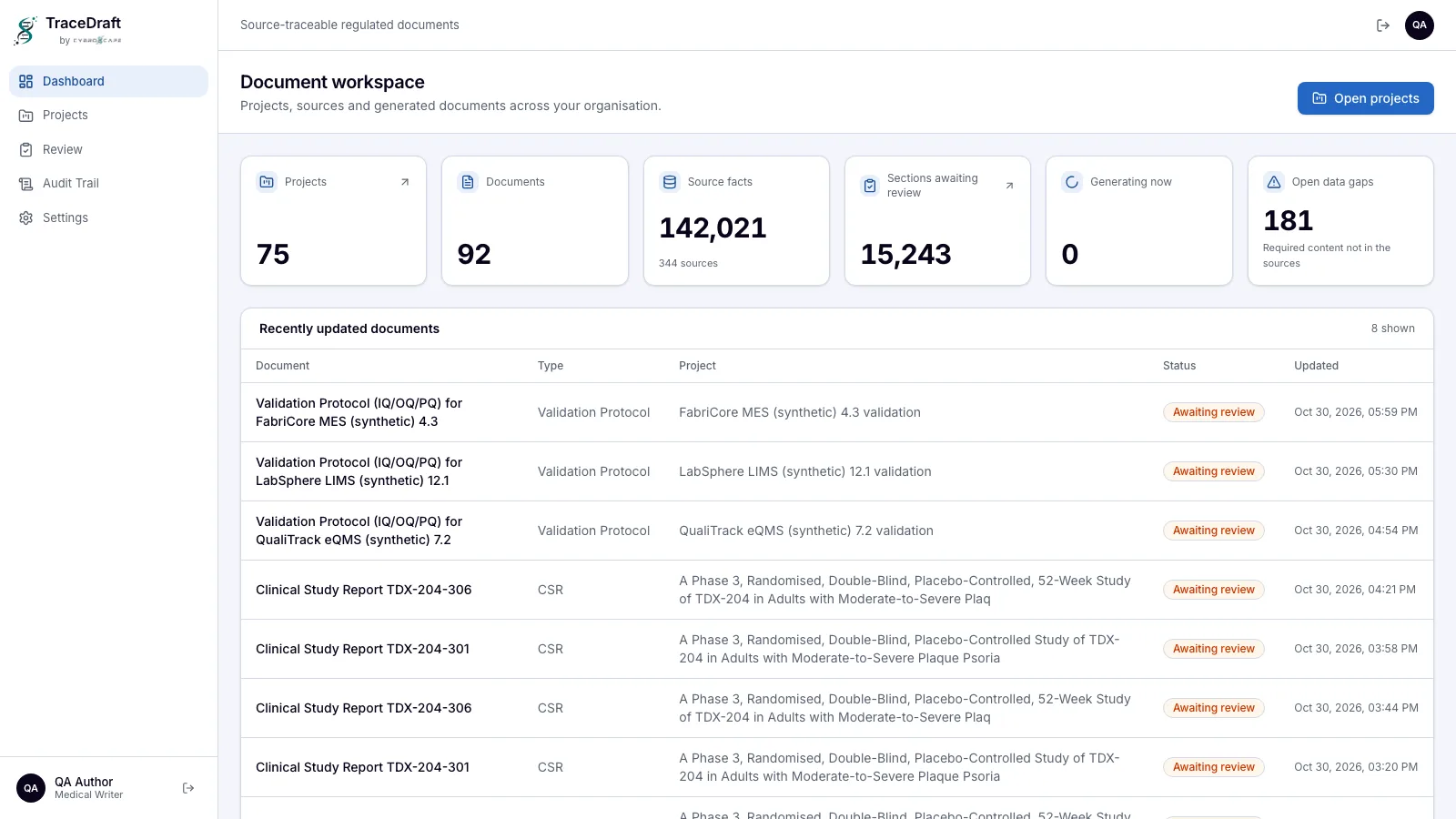
Clinical automation handles the repeatable mechanics around clinical documents — assembling a document set from source data, routing drafts through review, carrying defined values across a programme, and producing export packages with their evidence attached. The judgement stays human; the handling stops consuming a writer's week.
The work between the work
Ask a clinical operations lead where a submission timeline goes and a surprising share is not writing or review. It is assembling the right table versions, chasing which document is current, reformatting to a sponsor template, collating an export package, and checking that figures in text still match listings that were reissued on Tuesday.
None of this needs clinical judgement. All of it needs care, and it lands on the people with the least time and the most expensive judgement.
It is also where errors enter. Nearly every transcription error in a submission document arrives during a late-stage handling step rather than during authoring.
Assembly from the source, not by hand
Document sets are assembled from the current source data and defined values rather than collated manually. When a table is reissued, the statements depending on it are identifiable rather than needing a document-wide sweep.
That removes the specific step where most late transcription errors are introduced.
- 1Adverse event listing · row 14
- 2Lab dataset · ALT value, day 15
- 3Protocol · section 7.2
Routing that does not need chasing
Drafts move through review and approval with the current state visible — who has it, what is outstanding, what is blocked. The status question that currently costs a daily email thread is answerable by looking.
Partial acceptance means a document is not held hostage by one unresolved section, which is the usual reason a review cycle stalls.
Export with the evidence attached
An export carries its provenance and the compliance record with it rather than leaving them behind in the authoring tool. A sponsor or reviewer asking where a statement came from has an answer in the delivered package.
This is the point at which most tools in this category quietly lose their traceability, and it is the point at which it becomes valuable.
What you get
What Clinical Automation delivers
Clinical Automation is part of the TraceDraft platform — an AI-native, source-traceable clinical documentation system built for regulated Life Sciences. See how it fits with CSR Authoring, CTD Clinical Summaries, Document Analysis.
- Asynchronous generation and extraction
- Export as a review copy with source markers or a clean DOCX
- Swappable AI backend
- Retries and failure handling in the audit
Common questions
Prefer to talk first? Chat with us on WhatsApp or book a call with an expert.
What does clinical automation actually automate?
The handling rather than the thinking: assembling document sets from current source data, carrying defined values across a programme, routing drafts through review with visible status, and producing export packages with provenance and compliance evidence attached. Authoring judgement, interpretation and approval remain human.
Where do most errors enter a submission document?
During late-stage handling rather than authoring — a table reissued after the text was written, a version collated from the wrong folder, a figure retyped during reformatting to a sponsor template. These steps need care rather than clinical judgement, which is why they are worth removing from a writer's week.
Does automation reduce the review burden?
It reduces the chasing and the reconciliation around review, not the review itself. A qualified person still reads and approves every document. What changes is that they are not also tracking down the current table version, checking figures against reissued listings, or asking by email where a document has got to.
Related capabilities
All capabilitiesCompose Clinical Study Reports from your linked source data — AE listings, datasets, protocols — and generate the safety narrative appendix straight from the same source graph. One review workflow, one evidence pack, one traceable story from listing to submission.
Learn more about CSR AuthoringCTD Clinical SummariesDraft CTD Module 2.5 Clinical Overviews and Module 2.7 Clinical Summaries from your clinical study reports and integrated analyses. Each section carries the ICH M4E(R2) text it must satisfy, every sentence cites the study report passage or table behind it, and the benefit-risk conclusions stay with your writers.
Learn more about CTD Clinical SummariesDocument AnalysisUpload an existing CSR, a vendor validation protocol, an SOP or a guideline and TraceDraft analyses it against the structure it should follow: a section-by-section summary, what each required section covers, what is missing, and where the text disagrees with itself. Every finding cites the uploaded document.
Learn more about Document AnalysisSafety NarrativesA standard safety narrative template — Patient Identification, AE Description, Medical History, Study Drug, Clinical Course, Causality and Narrative Summary — with each section wired to the source types it needs. The final narrative slots directly into the CSR appendix.
Learn more about Safety NarrativesClinical DocumentationProject-scoped source management ingests the messy inputs — AE listings, datasets, protocols, PDFs — and turns them into the citable atoms behind every generated section. Writers see source coverage before they draft, so gaps are addressed early, not at QC.
Learn more about Clinical DocumentationHuman-in-the-Loop ReviewsA dedicated review queue routes generated sections to human reviewers with the source-link count in view — so reviewers validate AI output against the actual data behind it. The section status workflow keeps everyone honest about where a draft actually is.
Learn more about Human-in-the-Loop ReviewsSee clinical automation on your own data.
Bring a protocol, a TLF set or an AE listing. We show you a source-traced draft built from it.
- We reply within one business day
- We run your inputs live on the call
- You see every sentence linked to its source