Clinical Overview and Clinical Summary drafted from the study reports, every statement cited.
Draft CTD Module 2.5 Clinical Overviews and Module 2.7 Clinical Summaries from your clinical study reports and integrated analyses. Each section carries the ICH M4E(R2) text it must satisfy, every sentence cites the study report passage or table behind it, and the benefit-risk conclusions stay with your writers.
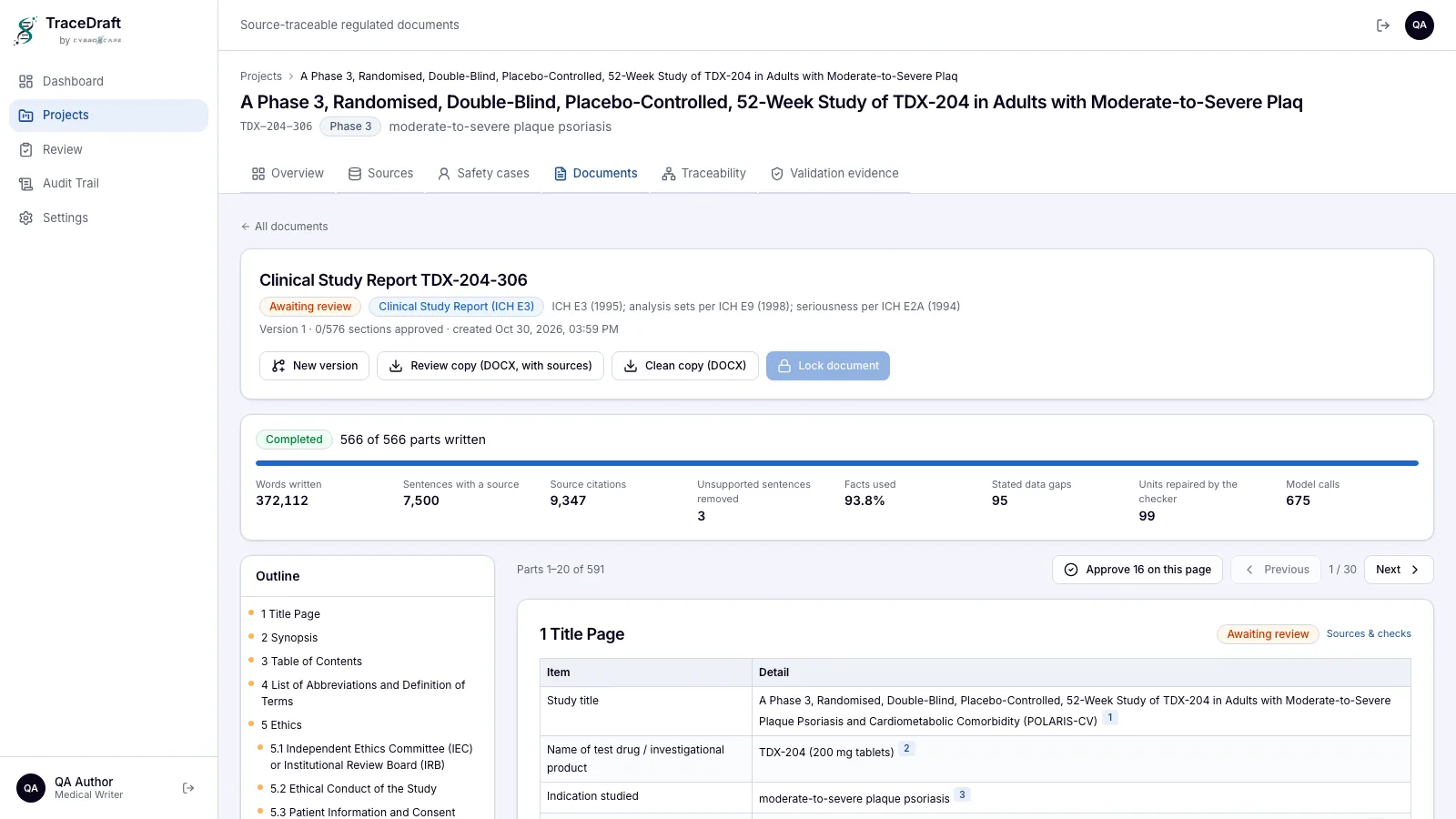
CTD Module 2.5 (Clinical Overview) and Module 2.7 (Clinical Summary) summarise a product's clinical data for a marketing application in the structure set by ICH M4E(R2). Cybroscape TraceDraft drafts both from your clinical study reports, cites every sentence to the passage or table it rests on, and leaves the benefit-risk conclusions to the medical writer.
Summaries written from documents that are still moving
Module 2 is written late, from study reports that are themselves still being finalised. Every figure in the Clinical Summary restates a number from a CSR or an integrated analysis, and each restatement is a chance for the two to drift apart.
The work is also long and repetitive: Module 2.7 walks through every study in the same pattern, and Module 2.5 has to say the same things more briefly without saying anything different.
Written against the guideline text
Each section of the blueprint carries the ICH M4E(R2) wording that governs it, so the draft is written to the requirement itself rather than to a writer's memory of it. Study-by-study sections of Module 2.7 follow one pattern for every study.
- 1Adverse event listing · row 14
- 2Lab dataset · ALT value, day 15
- 3Protocol · section 7.2
Numbers that match the study reports
Every sentence cites the CSR passage or table it rests on, and a number or date that does not appear in the cited source sends the part back for repair or removes the sentence. Where two sources disagree, both values are shown and the document cannot be locked until someone decides.
Conclusions stay with the writer
The benefit-risk discussion and the overall conclusions are judgements a qualified person makes. TraceDraft drafts the descriptive summary around them and states a data gap as a gap rather than filling it.
What you get
What CTD Clinical Summaries delivers
CTD Clinical Summaries is part of the TraceDraft platform — an AI-native, source-traceable clinical documentation system built for regulated Life Sciences. See how it fits with CSR Authoring, Document Analysis, Safety Narratives.
- CTD Module 2.5 Clinical Overview
- CTD Module 2.7 Clinical Summary, study by study
- ICH M4E(R2) requirements carried into each section
- Every sentence cited to a CSR passage or table
Common questions
Prefer to talk first? Chat with us on WhatsApp or book a call with an expert.
What is the difference between CTD Module 2.5 and 2.7?
Module 2.5, the Clinical Overview, is a short critical analysis of the clinical data and the benefit-risk conclusions. Module 2.7, the Clinical Summary, is a detailed factual summary of the clinical information, including study-by-study summaries. Both are defined by ICH M4E(R2).
Which parts of Module 2 can AI draft?
The factual summaries: study designs, populations, efficacy and safety results restated from the study reports and integrated analyses. The benefit-risk assessment and the conclusions require clinical judgement and should be written by the medical writer.
Does TraceDraft draft DSURs or Investigator Brochures?
Not today. The document types built are ICH E3 study reports, CTD Module 2.5 and 2.7, ICSR case narratives, validation protocols and SOPs. Periodic safety reports such as the DSUR and PBRER are on the roadmap, after CMC Module 3.
Related capabilities
All capabilitiesCompose Clinical Study Reports from your linked source data — AE listings, datasets, protocols — and generate the safety narrative appendix straight from the same source graph. One review workflow, one evidence pack, one traceable story from listing to submission.
Learn more about CSR AuthoringDocument AnalysisUpload an existing CSR, a vendor validation protocol, an SOP or a guideline and TraceDraft analyses it against the structure it should follow: a section-by-section summary, what each required section covers, what is missing, and where the text disagrees with itself. Every finding cites the uploaded document.
Learn more about Document AnalysisSafety NarrativesA standard safety narrative template — Patient Identification, AE Description, Medical History, Study Drug, Clinical Course, Causality and Narrative Summary — with each section wired to the source types it needs. The final narrative slots directly into the CSR appendix.
Learn more about Safety NarrativesClinical DocumentationProject-scoped source management ingests the messy inputs — AE listings, datasets, protocols, PDFs — and turns them into the citable atoms behind every generated section. Writers see source coverage before they draft, so gaps are addressed early, not at QC.
Learn more about Clinical DocumentationHuman-in-the-Loop ReviewsA dedicated review queue routes generated sections to human reviewers with the source-link count in view — so reviewers validate AI output against the actual data behind it. The section status workflow keeps everyone honest about where a draft actually is.
Learn more about Human-in-the-Loop ReviewsClinical AutomationGeneration, extraction and export run asynchronously so writers never wait for a spinner. Combined with the swappable AI provider, teams can automate draft production while keeping the human review gate exactly where it belongs.
Learn more about Clinical AutomationSources
Primary documents referred to on this page, from their official publishers.
See ctd clinical summaries on your own data.
Bring a protocol, a TLF set or an AE listing. We show you a source-traced draft built from it.
- We reply within one business day
- We run your inputs live on the call
- You see every sentence linked to its source