MDR-ready evidence with the same source-traceable engine.
Clinical Evaluation Reports authored with the same source-traceability engine used for CSRs — traceable claims, tamper-evident audit, MDR / IVDR-ready evidence, without a bespoke module.
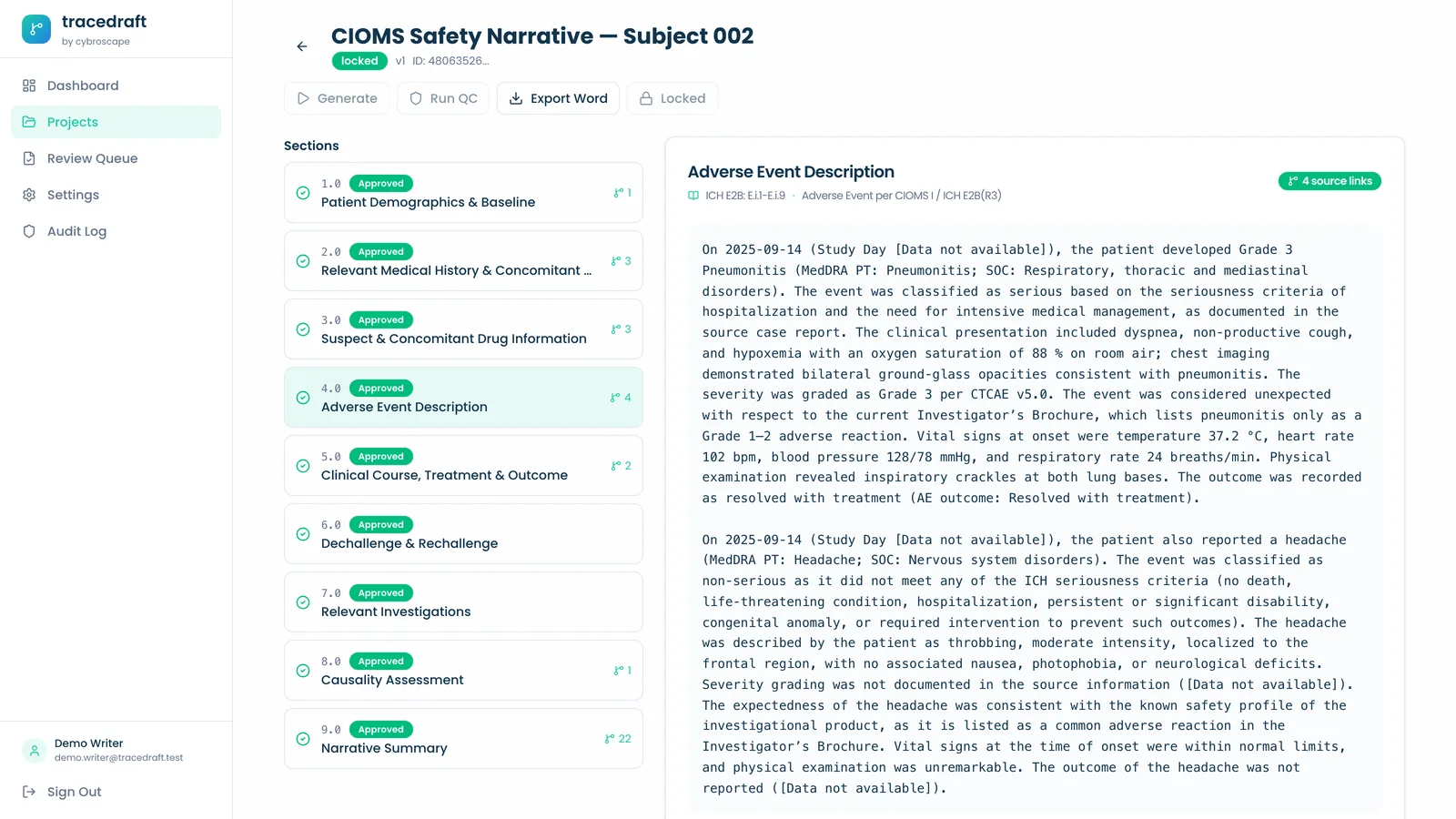
A Clinical Evaluation Report demonstrates that a medical device meets its clinical performance and safety requirements, under EU MDR Annex XIV and MEDDEV 2.7/1 rev 4. TraceDraft drafts the report from your appraised literature, clinical investigation data and post-market surveillance inputs, with every claim linked to the evidence supporting it.
A report that is never finished
Under MDR a clinical evaluation is continuous. New literature appears, post-market surveillance accumulates, the state of the art moves, and the CER has to be updated rather than written once and filed.
Most manufacturers handle this by rewriting substantial parts of the document each cycle, because there is no practical way to tell which conclusions the new evidence actually touches. The update becomes a project, so it slips, and the report ages.
Notified bodies have become notably less tolerant of CERs whose literature appraisal is two years stale or whose equivalence claims are asserted rather than demonstrated.
Claims tied to evidence, individually
Each clinical claim links to the specific appraised source supporting it — a study, an investigation result, a post-market data point. A notified body reviewer asking what supports a particular performance claim follows the link.
That linkage is what makes equivalence arguments defensible rather than asserted, and it is the part reviewers push hardest on.
- 1Adverse event listing · row 14
- 2Lab dataset · ALT value, day 15
- 3Protocol · section 7.2
Updates that touch only what changed
When new literature or surveillance data arrives, the conclusions it bears on are identifiable, so the update revises those sections and leaves the rest of the approved report unchanged.
A continuous obligation becomes a periodic, bounded task rather than a recurring rewrite that nobody has time to start.
Appraisal that shows its working
The literature search strategy, inclusion and exclusion decisions and appraisal of each source are recorded as part of the evaluation rather than reconstructed afterwards. A reviewer can see not just what was included but what was considered and rejected, and why.
What you get
What Clinical Evaluation Reports delivers
Clinical Evaluation Reports is part of the TraceDraft platform — an AI-native, source-traceable clinical documentation system built for regulated Life Sciences. See how it fits with CSR Authoring, Protocol Writing, Medical Writing.
- Same source traceability as CSRs
- Traceable claims per section
- MDR / IVDR-ready evidence
- Tamper-evident audit trail
Common questions
Prefer to talk first? Chat with us on WhatsApp or book a call with an expert.
What is a Clinical Evaluation Report?
A CER demonstrates that a medical device achieves its intended clinical performance and that its benefits outweigh its risks, based on appraised literature, clinical investigation data and post-market surveillance. Under EU MDR Annex XIV and MEDDEV 2.7/1 rev 4 it is a continuous obligation, updated as new evidence appears, not a one-time document.
How often must a CER be updated?
Continuously in principle, with the review frequency justified by the device's risk class and the rate at which relevant evidence appears — annually for higher-risk devices is common. Notified bodies have become markedly less tolerant of reports whose literature appraisal is visibly out of date.
What do notified bodies challenge most in a CER?
Equivalence claims asserted rather than demonstrated, literature appraisal that does not show what was considered and rejected, and conclusions that are not clearly tied to specific appraised evidence. All three are provenance problems: the reviewer cannot follow a claim back to what supports it.
Related capabilities
All capabilitiesCompose Clinical Study Reports from your linked source data — AE listings, datasets, protocols — and generate the safety narrative appendix straight from the same source graph. One review workflow, one evidence pack, one traceable story from listing to submission.
Learn more about CSR AuthoringProtocol WritingDraft and revise protocols and protocol amendments in one workspace with the study's sources and templates. Amendments inherit the audit trail and status workflow so revisions stay traceable and reviewable — not lost in tracked-changes.
Learn more about Protocol WritingMedical WritingA general-purpose medical writing workspace for Investigator Brochures, DSURs, IND annual reports, HAQ responses, IND packages and other regulatory documents. Writers work section-by-section against your templates, grounded in the source data that must support every claim.
Learn more about Medical WritingSafety NarrativesA standard safety narrative template — Patient Identification, AE Description, Medical History, Study Drug, Clinical Course, Causality and Narrative Summary — with each section wired to the source types it needs. The final narrative slots directly into the CSR appendix.
Learn more about Safety NarrativesLiterature ReviewsLiterature ingested once, cited everywhere — with the same traceability links used across the rest of the platform. Purpose-built literature-review tooling is on the roadmap.
Learn more about Literature ReviewsClinical DocumentationProject-scoped source management ingests the messy inputs — AE listings, datasets, protocols, PDFs — and turns them into the citable atoms behind every generated section. Writers see source coverage before they draft, so gaps are addressed early, not at QC.
Learn more about Clinical DocumentationSee clinical evaluation reports on your own data.
Bring a protocol, a TLF set or an AE listing. We show you a source-traced draft built from it.
- We reply within one business day
- We run your inputs live on the call
- You see every sentence linked to its source