Controlled documents with the lifecycle regulators expect.
Document Management System implementation and validation — draft → in-review → approved → effective → superseded / retired, plus periodic review.
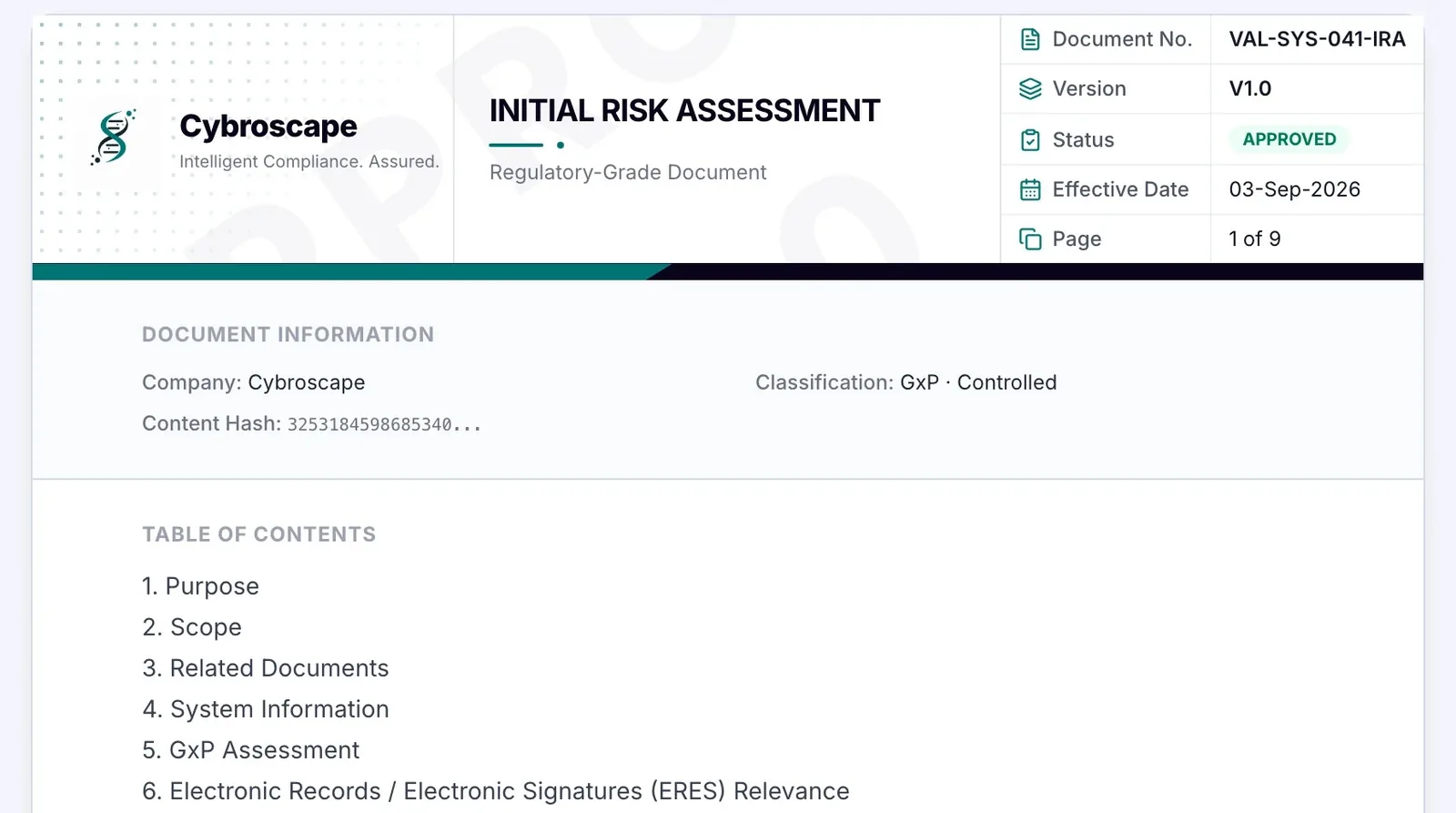
A document management system holds controlled documents through their lifecycle — authoring, review, approval, effective date, periodic review and retirement. In a GxP context what matters beyond storage is that approved versions cannot be altered, that superseded versions remain retrievable, and that the effective version is unambiguous to the person about to follow it.
Outcomes you can expect
- DMS validated
- Controlled document lifecycle
- Periodic review discipline
DMS Implementation is delivered by our regulatory services practice. Where it saves time, the team uses our products: GxP Copilot for validation lifecycle work and TraceDraft for clinical documentation.
Explore related capabilities: Regulatory Compliance, Regulatory Intelligence, Regulatory Information Management (RIM), eQMS Implementation & Validation.
The Controlled Document Lifecycle: What GxP Requires
Controlled documents in GxP environments — SOPs, specifications, validation protocols, batch records — must move through a defined lifecycle with documented transitions: draft, in review, approved, effective, under revision, superseded or retired. Each transition must be attributable (who approved the transition), auditable (when was the transition made and by whom), and controlled (only authorised personnel can approve transitions). A document management system that implements this lifecycle with Part 11-compliant electronic approvals and audit trails is the technical foundation of a compliant controlled document programme.
The most common failures in controlled document management are not in the document management system — they are in the processes surrounding it. Documents effective in the DMS but not reviewed on a defined periodic review schedule become stale over time. Documents approved in the DMS but not distributed to all affected personnel before implementation create training gaps. Documents archived in the DMS at retirement but without a defined retention and eventual destruction schedule create HIPAA and data protection compliance exposure for documents containing personal data.
DMS Implementation and Validation for Pharma and Medical Devices
Document Management System platforms in GxP environments include Veeva Vault QualityDocs, MasterControl, Documentum, SharePoint with validated configuration, and several quality-specific platforms (Sparta Systems TrackWise, ETQ Reliance). Each has different strengths: Veeva Vault QualityDocs integrates with the broader Vault regulatory content ecosystem; MasterControl provides deep quality event integration; SharePoint offers integration with the Microsoft ecosystem but requires more extensive configuration to implement GxP-compliant document lifecycle controls.
Our DMS validation practice delivers a GAMP Category 4 validation package — configuration specification, OQ test scripts targeting configured lifecycle transitions and access controls, Part 11 posture assessment, and a post-go-live periodic review framework. For SharePoint implementations, we design the site architecture, metadata schema, content type configuration, and Power Automate workflows that implement the GxP document lifecycle within the SharePoint platform, and validate the resulting configuration with OQ test scripts that verify lifecycle transition controls, access control enforcement, and electronic approval attribution.
Sources
Primary documents referred to on this page, from their official publishers.
See it on your own system.
Bring a URS or a system. We show you the validation package it produces.
- We reply within one business day
- We run your URS live on the call
- You get a clear plan and scope