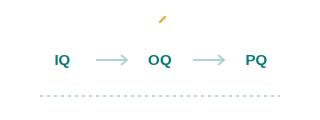
IQ, OQ and PQ are the three stages of qualification. IQ (Installation Qualification) proves the equipment or system was installed correctly. OQ (Operational Qualification) proves it works as specified across its operating range. PQ (Performance Qualification) proves it performs reliably in real use, with real materials, people and procedures.
Run them in that order, each with an approved protocol before you start and a signed report when you finish. Together they show a regulator that the thing you rely on for GMP work is fit for its intended use. This guide explains each stage, how PPQ fits in, and what inspectors actually look for, with examples for both equipment and software.
IQ, OQ, PQ and PPQ at a glance
| Stage | Question it answers | Typical evidence | Done by |
|---|---|---|---|
| IQ | Is it installed as designed? | Serial and model numbers, drawings, utilities, software versions, calibration certificates | Engineering or IT with QA approval |
| OQ | Does it work as specified across its range? | Function tests, alarms and interlocks, limits, audit trail and access tests | Validation or CQV engineers |
| PQ | Does it perform reliably in real use? | Runs with real or simulated product, trained users, approved SOPs, repeated results | Process owners and validation |
| PPQ | Does the whole commercial process make good product consistently? | Commercial-scale batches made under the final control strategy, with extra sampling | Manufacturing, QA and process development |
Utilities follow the same stages; see our water system qualification guide for PW and WFI. Before IQ, most programmes also run design qualification (DQ), which checks the design against the user requirements. Factory and site acceptance tests (FAT and SAT) often come between DQ and IQ for equipment. EU GMP Annex 15 lists all of these as qualification stages.
What Installation Qualification (IQ) checks
IQ confirms that what arrived and what was installed match the approved design and the supplier's instructions. It is a check of facts, not of performance. If a wrong component, an old software version or a missing utility slips through here, every later test is built on the wrong base.
- Model, serial number and components match the purchase order and design.
- Utilities such as power, water, compressed air and HVAC are connected and within specification.
- Drawings, manuals and spare parts lists are received and filed.
- Instruments that need it are calibrated, with certificates on file.
- For software: the version, build, configuration baseline, interfaces and user roles are recorded.
A simple example: for a new HPLC, IQ records the module serial numbers, the firmware and data system versions, the lab conditions and the network connection to the data system. For a LIMS, IQ records the server build, database version, installed modules and the configured user roles.
What Operational Qualification (OQ) checks
OQ tests that the equipment or system does what the specification says, across the full range you will use. It is where most of the test cases live. Tests cover normal operation and also the edges: upper and lower limits, alarms, interlocks, power failure and recovery.
- Each functional requirement is tested against acceptance criteria written in advance.
- Alarms, interlocks and safety features trigger when they should.
- Operating ranges hold, for example temperature, speed or pressure, at the limits you will use.
- For software: access controls, audit trails, electronic signatures, calculations and backup and restore.
Back to the HPLC: OQ checks flow rate accuracy, detector linearity, injector precision and column oven temperature against defined limits. For the LIMS, OQ checks that each workflow, calculation and specification check works, and that a user without the right role cannot approve a result.
Risk should set how deep OQ goes. Under GAMP 5 Second Edition and the FDA's Computer Software Assurance guidance, high-risk functions get scripted tests and low-risk functions can rely on unscripted testing or supplier evidence.
What Performance Qualification (PQ) checks
PQ shows the equipment or system works reliably in daily use. It runs in the real environment, with trained people, approved procedures and real or representative materials. The aim is consistency over time, so PQ usually repeats runs or covers a set period.
- Runs use real product, a placebo or representative test loads.
- Operators follow the approved SOPs, not the engineer's notes.
- Results stay within limits across repeated runs, shifts or loads.
- For software: real users complete real business processes from start to finish.
For the HPLC, PQ might run a system suitability test with a reference standard over several days. For the LIMS, PQ follows real samples from login to approved certificate of analysis. Annex 15 says PQ normally follows IQ and OQ, but allows it to be combined with OQ or with process validation where that makes sense.
Where PPQ fits: process performance qualification
PPQ is a different level. IQ, OQ and PQ qualify one piece of equipment or one system. PPQ qualifies the whole manufacturing process at commercial scale, using qualified equipment, trained staff and the final control strategy.
The term comes from the FDA's 2011 guidance, Process Validation: General Principles and Practices. It splits process validation into three stages. Stage 1 is process design. Stage 2 is process qualification, which covers qualifying facilities, utilities and equipment and then running PPQ. Stage 3 is continued process verification during routine production.
So IQ, OQ and PQ of the equipment come first and feed into PPQ. A common question is how many PPQ batches you need. Neither the CGMP rules nor the FDA guidance set a number. You choose and justify it from your process knowledge and risk. Three batches is a common choice, but it has to be justified, not assumed.
IQ, OQ and PQ for software and computer systems
The same three stages apply to computerised systems such as LIMS, MES, eQMS and data systems. The names are optional here. GAMP 5 Second Edition talks about specification and verification, and many teams map their tests to IQ, OQ and PQ because inspectors know the terms.
What changes for software is the content. IQ captures versions and configuration. OQ leans heavily on data integrity controls: audit trails, access, electronic signatures and calculations. PQ proves real users can run the business process end to end. Supplier testing can cover much of the standard function, so your effort goes on your configuration. Our guide to equipment qualification and CSV together covers systems that are both.
How to run IQ, OQ and PQ: a practical sequence
- Write and approve the user requirements specification (URS).
- Run a risk assessment to decide what needs testing and how deeply.
- Complete DQ, then FAT and SAT for equipment where they apply.
- Write the IQ, OQ and PQ protocols with acceptance criteria, and get them approved before execution.
- Execute each stage in order, recording results as you go and raising deviations for anything that fails.
- Close each stage with a signed report before moving to the next.
- Update the traceability matrix so every requirement links to its test and result.
- Hand over to routine use with change control, calibration and periodic review in place.
You can reuse good commissioning and FAT/SAT evidence instead of repeating the tests, if it was done under suitable controls and QA has reviewed it. Our post on using commissioning evidence in qualification explains the conditions. For ready-made structures, see our free IQ, OQ and PQ protocol templates.
Common mistakes inspectors find
- Protocols signed after testing started, so the acceptance criteria look written to fit the results.
- Acceptance criteria that are vague, such as "works correctly", with no number or limit.
- Deviations closed without a root cause, or with no assessment of impact on earlier results.
- PQ run by engineers instead of the trained operators who will use the system.
- Software versions or configuration changed between OQ and PQ with no change control record.
- No link from requirements to tests, so nobody can show every requirement was tested.
- No plan for requalification after changes, moves or long periods out of use.
Most of these are record problems, not engineering problems. A good template and a live traceability matrix prevent nearly all of them.
When to requalify
Qualification is not a one-off event. Annex 15 expects equipment and systems to be reviewed at set intervals to confirm they stay in a qualified state. Requalify when something changes that could affect it: a repair, a move, a software upgrade, a new product or a trend of failures. Change control should ask that question every time, and the answer should be in the record.
How GxP Copilot helps with IQ, OQ and PQ
Writing the protocols is where most qualification time goes. Cybroscape GxP Copilot drafts the URS, the risk assessment and the IQ, OQ and PQ protocols from your equipment or system details, and keeps the traceability matrix current as you execute. Qualified people review, approve and sign every document. See how it handles equipment qualification, or read about automating IQ, OQ and PQ execution.
Where to go next
Explore Cybroscape GxP Copilot for AI-native validation, Cybroscape TraceDraft for source-traceable clinical documentation, or book a demo to see either on your own data.